Saturday, June 24, 2023

When I find myself in times of trouble, GOD alone is my refuge


God is our refuge and strength, a very present help in trouble.  Therefore we will not fear though the earth gives way, though the mountains be moved into the heart of the sea, though its waters roar and foam, though the mountains tremble at its swelling.  --Psalm 46:1-3

Continuing in our study of the book of Psalms, I want to kind of pull back the curtain a little bit, and take a look behind the scenes.  Every poet had his own experience to draw from when he or she writes verse.  The reader may insert his or her own life experience into the words to take a personalized meaning from it, but the original reason for writing, the initial motivation for memorializing the moment on paper does not change.

We are given a little bit of  background in a few of the Psalms.  Thirteen of them have a preamble or preface giving us a glimpse into the events leading up to the words.  The first Psalm like this was one we have already looked at, Psalm 3 (see post from May 14 entitled Cover Me.)  The preface to that chapter indicates authorship and an event or season in that person's life that inspired the writing.  It says, "A Psalm of David, when he fled from Absalom his son."  

If you read 2 Samuel 15:13-29, you will see how David's third son Absalom (whose name means "my father is peace") attempted a coup by staging a revolt against King David.  The young prince set himself up as king in his father's absence.  David's response was a prayer that God would save him and "strike all my enemies on the cheek," and "break the teeth of the wicked."  As a military strategist, his hope was to hold onto the throne and put down the one who was trying to usurp his throne.  As a father, he hoped God would not deal too harshly with his son; maybe just give him a slap in the face to wake him up, or as we might say today to give him a slap on the wrist and send him home where he can't hurt anybody (toothless, as it were.)

The second Psalm with such a preface also likely deals with the Absalom situation indirectly, although Bible scholars are unsure of the exact reference.  Psalm 7 begins, "A Song of David, which he sang to the Lord concerning the words of Cush, a Benjamite."  Some think this refers to 2 Samuel 16:5-13.  A relative of Saul, the king of Israel before David, hurling insults and cursing David as he pursued Absalom.  Saul was of the tribe of Benjamin, and Saul's father was called Kish (which is similar sounding to Cush).  There is also some evidence that the Hebrew word cushi was in itself a curse.  Other scholars believe it is a reference to 2 Samuel 18:21-32, when David's general Joab sent a Cushite messenger to tell David that the civil was was over, and that his son Absalom was dead (although there is no connection with the tribe of Benjamin here).

I think it is more likely to be the second example, because there are a number of emotions expressed in the 7th Psalm that might be experienced by a victorious warrior who is also a grieving father.  In any case, we know that David's response to the situation was to go to God.

We go to God for Refuge

Let's read the first two verses here.

O Lord my God, in You do I take refuge; save me from all my pursuers and deliver me, lest like a lion they tear my soul apart, rending it in pieces, with none to deliver.  --Psalm 7:1-2

The messenger sent by Joab in 2 Samuel 18 delivered his message of Absalom's demise with the words, "May all of your enemies and all those who rise up against you for evil be like that young man."  Although it was not what David wanted to hear, it meant that justice had been done.  It showed that God had delivered David from the evil brought by his own family, and that God's will had been done in the lives of both David and his son, as well as for the nation of Israel.  It also showed that God dealt with Absalom's sin.

God had shown Himself as the protector of the kingdom of Israel and of the king.  He had poured out His wrath on the evil one who had tried to take the throne by force.  David recognized that God was in control, even though it did not turn out the way he (David) had wanted.  If God is to be our refuge, then we must trust Him for the outcome.

We go to God in Repentance

Deep in his heart, David knew that his son Absalom had sinned.  He wanted to make sure that he did not end up with the same outcome that had befallen his son.  Let's read what David said next.

O Lord my God, if I have done this, if there is wrong in my hands, if I have repaid my friend with evil or plundered my enemy without cause, let the enemy pursue my soul and overtake it, and let him trample my life to the ground and lay my glory in the dust.  --Psalm 7:3-5

Part of David's emotions must have been something that all fathers experience when our children suffer: "O God, why couldn't it have been me instead?"  Yet in his grief he cried out to God to convict him of any unconfessed sin, so that the same fate would not be handed to David as had been given to Absalom.  I don't believe David was being vindictive here--he was not saying, "Absalom got what he deserved; if you play with the ox, you might get gored."  Instead, I believe David was saying that but for the grace of God he might have met the same fate as Absalom.  

God's wrath is real.  We don't preach it very much any more in our pulpits, but in 1741 Jonathan Edwards preached the sermon "Sinners in the hands of an angry God," which caused widespread revival in England.  A hundred years later Charles Spurgeon wrote, "If sinners be damned, at least let them leap to hell over our bodies.  If they will perish, let them perish with our arms about their knees. Let no one go there unwarned and unprayed for."  We must confess and repent.  1 John 1:9 says, "If we confess our sins, He is faithful and just to forgive us our sins, and to cleanse us from all unrighteousness."

We go to God with Reliance in Him

David was the king.  He could do whatever he wanted.  But he knew that God alone was in charge.

Arise, O Lord, in Your anger; lift Yourself up against the fury of my enemies; awake for me; You have appointed a judgment.  Let the assembly of peoples be gathered about You; over it return on high.   --Psalm 7:6-7

Many of us (even Christians) believe in self reliance.  Emerson said, "To be yourself in a world that is constantly trying to make you something else is the greatest accomplishment."  Unfortunately, this statement is untrue.  If we are true to ourselves only, we fall into sin.  We must not do what comes naturally to us, but we must be obedient to what God tells us to do.  The best way to do that is to be faithful to a local church body that believes the Bible and preaches grace by faith in Christ alone as outlined in Scripture for the glory of God.

It's not following the crowd that we should avoid; it is following the wrong crowd.

We go to God for Righteousness

David knew that God was sovereign, that He was righteous, and that He would judge the nations.

The Lord judges the peoples; judge me, O Lord, according to my righteousness and according to the integrity that is in me.  Oh, let the evil of the wicked come to an end, and may You establish the righteous--You who test the minds and hearts, O righteous God!  My shield is with God, who saves the upright in heart.  God is a righteous judge, and a God who feels indignation every day.  If a man does not repent, God will whet His sword; He has bent and readied His bow; He has prepared for Him His deadly weapons, making His arrows fiery shafts.  Behold, the wicked man conceives evil and is pregnant with mischief and gives birth to lies. He makes a pit, digging it out, and falls into the hole that he has made.  His mischief returns upon his own head, and on his own skull his violence descends.  I will give to the Lord the thanks due to His righteousness, and I will sing praise to the Name of the Lord, the Most High.  --Psalm 7:8-17

He knew that God had judged Absalom righteously--it was not God's will that the royal line of succession should go through Absalom, and there is no record in Scripture that Absalom had ever sought God in the matter.  James 4:6 quotes Proverbs 3:34 when it says, "God resists the proud but gives grace to the humble."  1 Peter 5:6 says, "Humble yourselves, therefore, under the mighty hand of God, so that He may exalt you in due time."

It is only by God's grace that we draw our next breath.  Who are we to question Him?  Even if our whole world falls apart, we can trust Him fully.  He is our refuge.  If we repent and believe, we can rely on Him to be our righteousness. 


Sunday, May 21, 2023

Steps to peace with God.


And He said to them, "Go into all the world and proclaim the gospel to the whole creation."  --Mark 16:15

I grew up in a Baptist church.  Our denomination was very evangelical--not Evangelical as in the political subgroup of Christians that pollsters target today, but we were taught to share our faith to everyone we met.  There were little booklets, called tracts, that were given out to help us in our witnessing endeavors.  They went under various titles: The Four Spiritual Laws, Steps to Peace with God, and others.   They all had the same basic message: God is holy, but He loves us; sin separates us from God; we need a Savior; and life with God is possible through our faith in Jesus Christ.

In my walk through the book of Psalms this past month, I have discovered that these four principles are not new.  The Old Testament points to the Gospel, and many of the Psalms are labeled "Messianic", for they look forward to a Savior.  However, when I read Psalm 36 this week, I was reminded of those little evangelistic tracts we used to carry with us everywhere.

Man is inherently sinful

Transgression speaks to the wicked deep in his heart; there is no fear of God before his eyes.  For he flatters himself in his own eyes that his iniquity cannot be found out and hated.  The words of his mouth are trouble and deceit; he has ceased to act wisely and do good.  He plots trouble while on his bed; he sets himself in a way that is not good; he does not reject evil.  --Psalm 36:1-4

Anywhere you go you can see that the world is going to hell.  People no longer hide their sin or expect us to turn a blind eye to it; sin is now celebrated and exalted.  It seems the media is doing a better job of proselytizing sinners to go deeper in sin than the Church is doing in gaining converts to heaven.

It has been so since the Fall described in Genesis.  God gave Adam, Eve, and their family a paradise on earth.  They had no need for anything--all good things were theirs for the asking.  However, Satan came in the form of a Serpent and tempted them, promising they could have more than what God was offering.  Ever since, we have been separated from God.  As David wrote in our text today, where there is no fear of God, transgression speaks to us in our innermost being.

The Hebrew word for "transgression" is sometimes translated "rebellion".   If we rebel against God, it is not God who condemns, for as Jesus said in John 3:17-18, "For God did not send His Son into the world to condemn the world, but in order that the world might be saved through Him.  Whoever believes in Him is not condemned, but whoever does not believe is condemned already, because he has not believed in the Name of the only Son of God."  We stand condemned by our own actions, but the consequences are dire: eternal separation from a Holy God.  Psalm 5:10 says, "Make them bear their guilt, O God; let them fall by their own counsels; because of the abundance of their transgressions cast them out, because they have rebelled against you."  This is right and just; God will not welcome an enemy combatant or a spiritual rebel into His holy presence.

God's love is greater than our sin.

Your steadfast love, O Lord, extends to the heavens, Your faithfulness to the clouds.  Your righteousness is like the mountains of God; Your judgments are like the great deep; man and beast you save, O Lord.  --Psalm 36:5-6

The World loves to take this spiritual truth out of context: God is Love.  Unfortunately, they equate love with agreement with their wicked hearts and acceptance of their sinful works.  God does love us, but He cannot abide sin.  In the Old Testament He set up a system of blood sacrifices for sin, because sin leads to death.  

Did you know the word "scapegoat" is from the Bible?  Leviticus 16 says that the priests were to select a goat, and that he would lay his hands on the goat's head as a symbol of transferring all the sins of Israel onto the head of the goat.  The goat was then set outside the camp, to fend for itself in the desert.  This was probably a death sentence, since in the desert there is no water, and a kid goat would be a great meal for birds of prey.

Psalm 51:3 says, "For I acknowledge my transgressions; my sin is ever before me."  This is the first step in getting right with God: confessing that you are a sinner, and realizing that only God can save you from the penalty of sin.  Psalm 89:32 says, "Then I will punish their transgressions with the rod and their iniquity with stripes."  Thank God that Isaiah 53:5 shows that God has a remedy for us, to deal with our sin.  It says, "But He was wounded for our transgressions, He was bruised for our iniquities; the chastisement for our peace was upon Him, and by His stripes we are healed."  Jesus became our "scapegoat", and bore the punishment for our sin.  

We must believe in Him, and trust Him fully for our salvation

How precious is Your steadfast love, O God!  The children of mankind take refuge in the shadow of Your wings.  They feast on the abundance of Your house, and You give them drink from the river of Your delights.  For with You is the fountain of life; in Your light do we see light.  --Psalm 36:7-9

If we truly believe in God's deliverance from sin, then we will repent of it all.  Psalm 25:7 says, "Remember not the sins of my youth or my transgressions; according to Your steadfast love remember me, for the sake of Your goodness, O Lord!"  This verse implies that "the sin of our youth" is the folly we followed before we placed our faith in Him, and that now, as a more mature person, we are no longer controlled by sin but rather provoked by the steadfast love of God to good works.

A prayer of repentance will look something like Psalm 51:1-2, which says, " Have mercy on me, O God, according to Your steadfast love; according to Your abundant mercy blot out my transgressions.  Wash me thoroughly from my iniquity, and cleans me from my sin."  Romans 6:13-14 says, "Do not present your members to sin as instruments for unrighteousness, but present yourselves to God as those who have been brought from death to life, and your members to God as instruments for righteousness.  For sin will have no dominion over you, since you are not under law but under grace.

Sin leaves us in darkness; God's mercy brings us into the Light.  Jesus is the Light (John 8:12).  Sin brings death; God's mercy gives Life.  Jesus is the Way, the Truth, and the Life (John 14:6).  Our faith is in Jesus alone, because He is the atonement for our sin.

Once we place our trust in Him, we are secure

Oh, continue Your steadfast love to those who know You, and Your righteousness to the upright of heart! Let not the foot of arrogance come upon me, nor the hand of the wicked drive me away.  There the evildoers lie fallen; they are thrust down, unable to rise.  --Psalm 36:10-12

God is faithful.  He has provided the perfect sacrifice for our sin.  Psalm 103:11-12 says, "For as high as the heavens are above the earth, so great is His steadfast love toward those who fear Him; as far as the east is from the west, so far does He remove our transgressions from us."  Think about that for a minute.  The sin which placed us in darkness, separated us from God's presence, and guaranteed certain death, was taken away from us by the blood of Jesus.  It was not removed a few yards, or a few miles, or a few lightyears.  The earth has a north pole and a south pole; if He had said our sin was removed as far as the north is from the south, it would be a finite distance.  On the other hand, east and west are an infinite distance apart.  On the earth, no matter how far west you go, you can go still farther.  The same with east--you can go east forever, and there is still more east of your position. 

We still have that sinful nature, and as long as we are alive on this earth we will fall.  1 John 2:1-2 says, "My little children, I am writing these things to you so that you may not sin.  But if anyone does sin, we have an advocate with the Father, Jesus Christ the righteous."  He is our righteousness.  We do not have to fear falling out of His favor.

Thus we find that the Psalms held the Gospel of Salvation in four easy steps.  The concept is more fully developed the further you read in the Scripture.  That is why we are commanded in Matthew 28 to go into all the world and make disciples, not just converts.  The more we know of Jesus, the better prepared we are for life's uncertainties, and the more prepared we are for the next life.  If you have not trusted Him as your Savior, I would encourage you to do so right now, at this very moment.

Sunday, May 14, 2023

Cover Me


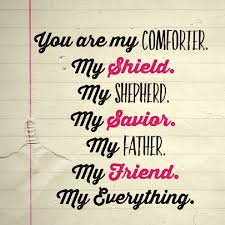
O my Savior, Shield, and Sun, Shepherd, Brother, Husband, Friend, Every precious Name in one, I will love Thee without end.  --John Newton

The Psalms is a rich and diverse source of scriptural wisdom.  In it you can find solace, strength, and sustenance.  It is at different times potent, piercing, and prophetic.  The poetry contained in this collection have varied themes.  We have already looked at the theme of the Law of God (see blog post from April 29).  We have also seen the theme of praise in the Psalms (see blog post from May 7).

Today I want to look at the theme of who God is.  We could spend years expounding the attributes of God in the Psalms.  God certainly wears a lot of hats, so to speak.  He manifests Himself differently to different people, yet remains consistent with His nature.  The Apostle Paul, in imitating Christ in order to spread the Gospel, said he had "become all things to all people in order that I might save some." (1 Corinthians 9:23).  Today I want to focus on three distinct yet similar personas.

Let's look at Psalm 3 together

O Lord, how many are my foes!  Many are rising against me; many are saying of my soul, "There is no salvation for him in God." Selah.  But You, O Lord, are a Shield about me, my Glory, and the Lifter of my head.  I cried aloud to the Lord, and He answered me from His holy hill.  Selah.  I lay down and slept; I woke again, for the Lord sustained me.  I will not be afraid of many thousands of people who have set themselves against me all around.  Arise, O Lord!  Save me, O God!  For You strike all my enemies on the cheek; You break the teeth of the wicked.  Salvation belongs to the Lord; Your blessing be on Your people.  Selah.

He is a Glorious Shield

Many of the Psalms have a military theme.  A warrior on the front lines of battle has prepared himself the best he can for his own protection.  He trusts his equipment; a modern soldier with a Kevlar vest feels less vulnerable than one without.  He trusts his comrades; a squadron willing to "take a bullet for you" is a lot more preferable than comrades in arms who would cut and run, leaving you exposed.  He also trusts his Commander; a wise leader will at least attempt to take every advantage--taking high ground, flanking the enemy at their weakest or most vulnerable position, bringing in timely air support and reinforcements.  These are all ways to think of a "shield" in military terms.

I have said before that I am not a Hebrew scholar.  However, a look at Strong's Concordance reveals that there are at least two Hebrew words translated "shield".  One is mâgên,  a word that literally means shield or buckler.  It also carries with it the idea of the scaly hide of a crocodile.  This word is found 60 times in the Old Testament, beginning with Genesis 15:1.  "After these things the word of the Lord came to Abram in a vision: 'Fear not, Abram, I AM your shield; your reward shall be very great'."

Abram had no reason to fear, because God had promised to be his covering, his defense.  God promised to defend Israel.  "Our soul waits for the Lord; He is our help and our shield.  For our heart is glad in Him, because we trust in His holy Name." (Psalm 33:20-21).  God cannot bless you unless He protects you.  If He has made a promise to His people, then He will protect His people.  The promise extends to those of us who place our trust in Him for our salvation.  "For the Lord God is a sun and shield; the Lord bestows favor and honor.  No good thing does He withhold from those who walk uprightly." (Psalm 84:11)

The other Hebrew word translated "shield" is tsinnâhand it is variously translated as shield or buckler, but several times it is translated "target," once as "hook" and once as "cold".  In 1 Kings 10 and again in 2 Chronicles 9 we read that Solomon made expensive shields or "targets" out of beaten gold.  I am not sure if these shields were round and looked like targets, but I do know that they were of great value.  Think about how God shields us from attacks we don't even know about.  He makes Himself the target so that we are protected.  He is our shield, of more value than gold.

Proverbs 25:13 says, "Like the cold of snow in the time of harvest is a faithful messenger to those who send him; he refreshes the soul of his master."  The word translated "cold" is the same word shield or covering.  The protection of God is refreshing.  In military terms, we speak of "cover fire"; that is, shots taken by your partners to pin down the enemy so that you can escape a dangerous place or move into a more strategic position.  This is what I thought of when I thought of the cold covering or shielding of snow over the fields; it is comprehensive, overpowering, and effective.  There is a similar thought in Scripture when the same word for shield is translated "hooks" in Amos 4:2.  "The Lord has sworn by His holiness that, behold, the days are coming upon you, when they shall take you away with hooks, even the last of you with fishhooks." It may be stretching the idea a bit, but when God sends "cover fire" to shield His people from their enemies, the enemies are pierced and taken away.

Psalm 91:4 says, "He will cover you with His feathers, and under His wings you will find refuge; His faithfulness is a shield and a buckler."  This may have been in Jesus' mind when He said in Matthew 23:27, "O Jerusalem, Jerusalem, the city that kills the prophets and stones those who are sent to it!  How often would I have gathered your children together as a hen gathers her brood under her wings, and you were not willing!"  His desire is to shield us, to shepherd us, to save us.

He is a Good Shepherd

We read Psalm 3 earlier.  I bring you attention back to verses 5 and 6: "I lay down and slept; I woke again, for the Lord sustained me.  I will not be afraid of many thousands of people who have set themselves against me all around."

We are all familiar with Psalm 23.

The Lord is my shepherd; I shall not want.  He makes me lie down in green pastures.  He leads me beside still waters.  He restores my soul.  He leads me in the path of righteousness for His name's sake.  Even though I walk through the valley of the shadow of death, I will fear no evil, for You are with me; Your rod and Your staff, they comfort me.  You prepare a table for me in the presence of my enemies; You anoint my head with oil; my cup overflows. Surely goodness and mercy shall follow me all the days of my life, and I shall dwell in the house of the Lord forever.

We see from this passage that He is our shepherd.  What does a good and faithful shepherd do?  He is present with the sheep; he provides for the sheep; and he protects and defends the sheep.  This idea is outlined further in John 10, when Jesus called Himself the Good Shepherd.

Jesus said to them, "Truly, truly I say to you, I am the door of the sheep.  All who came before me are thieves and robbers, but the sheep did not listen to them.  I am the door.  If anyone enters by Me, he will be saved and will go in and out and find pasture.  The thief comes only to steal and kill and destroy.  I came that they may have life and have it abundantly.  I am the good shepherd.  The good shepherd lays down his life for the sheep."  --John 10:7-11.

This brings us to our final point.

He is a Great Savior

Back to our passage in Psalm 3.  Let's read verses 2 and 8.  "Many are saying of my soul, 'There is no salvation for him in God.'  Salvation belongs to the Lord; Your blessing be on Your people!"  For what purpose is He shielding us?  For our own health and well being?  I don't think so.  It is for His glory.  Psalm 40:16 says, "Let all those who seek You rejoice and be glad in You; let such as love your salvation say continually, 'The Lord be magnified'!"  Psalm 18:46 says, "The Lord lives! Blessed by my Rock!  Let the God of my salvation be exalted." 

For what purpose or to what end does He shepherd us?  So that we can be slaughtered and roasted and served up at His table?  Not at all!  He guides us so that we can ultimately glorify Him and give Him praise forever.  Titus 3:5-7 says "He saved us, not because of works done by us in righteousness, but according to His own mercy, by the washing of regeneration and renewal of the Holy Spirit, whom He poured out on us richly through Jesus Christ our Savior, so that being justified by His grace we might become heirs according to the hope of eternal life."

We need mercy, because we are eternally separated from His holy nature due to our sinful nature.  We need grace, because we cannot be made holy without His direct intervention.  2 Corinthians 9:15 says, "Thanks be to God for His inexpressible gift!"  What gift is that?  Ephesians 2:8 says, "For by grace you have been saved through faith.  And this is not your own doing; it is the gift of God."  Psalm 22 foretells of this gift: God sent His one and only Son (John 3:16), and used Him as a sacrifice for us.  The sin of all mankind, past and future, was laid on Him and He was put to death for us.  "My God, My God, why have you forsaken me," Jesus cried, referencing Psalm 22:1.  He bore our sin, and a Holy God could not look upon sin, so that He turned away from His only Son and condemned Him to death.  Psalm 22:7 says, "All who seek me mock me; they make mouths at me; they wag their heads; 'He trusts in the Lord; let God deliver him'." This is just what the Pharisees said when Jesus uttered those devastating words, "My God why have You forsaken me?"  Psalm 22:17-18 says, "I can count all my bones--they stare and gloat over me; they divide my garments among them, and for my clothing they cast lots."  This is exactly what happened at the crucifixion, and God foretold it through David the Psalmist.

Our salvation was purchased through the death, burial, and resurrection of Jesus Christ, God's anointed. Psalm 2:2 says, "The kings of the earth set themselves, and the rulers take counsel together, against the Lord and against His Anointed."  Friend, do not follow the rulers of this world, who have their reward in this life.  Let Him shield you from the wrath to come.  Let Him shepherd you in His Way so that you can praise Him in this life and enjoy Him in the next.  Let the blood of Christ cover you, so that when you stand before God in His final judgment, He will not see your sin, but rather the blood of Jesus who by His great sacrifice offers a great salvation.


Saturday, May 6, 2023

Worthy of our praise


I will give to the Lord the thanks due to His righteousness, and I will sing praise to the name of the Lord, the Most High.  --Psalm7:17

One of the great themes in the book of Psalms is praise.  According to Strong's Concordance, there are 132 verses in the book of Psalms that use the word at least once; a form of the word is used over 150 times in this one book alone.

Last week we started our study of the book of Psalms with the first chapter, which centers on the Law.  We saw that there are blessings that follow those who follow the Law, and wickedness follows those who do not pursue it with their whole heart.

Today I am going to skip to the last chapter, which centers on praise; specifically the praise of God.  We will try to show how one logically follows the other--how the Law of God leads to the praise of Him.  Praise is a form of worship, but it is so much more.

I am not a Hebrew scholar (by any means!), but Strong's shows me at least four Hebrew words that are translated "praise" in English.  The first is t'hilla (tranliterating into the English alphabet).  It is a noun, as in giving praise to God.  It means praise, adoration, thanksgiving, and glory, all of which God deserves.  The second Hebrew word is zamar, a verb meaning to sing praise or make music.  Many of the Psalms in our Bible were set to music and were either played or sung in the Temple.  The third term is yada, which is most interesting, because it means to throw or cast down, to give thanks or laud (something or someone), and to confess.  I can imagine the sincerest form of praise might be when we first see Jesus in heaven--we might throw ourselves to the ground, thanking Him profusely for His great mercy and sacrifice, and confessing His great might and power.

The fourth Hebrew word translated "praise" is halal and it is where we get our word "Hallelujah".  The Hebrew word literally means to shine, to be boastful, or to be commended.  When combined with the first syllable of the name Jahweh, we get halal-Ja, or Praise God.  More specifically, it is glorifying His name, to boast about Him, to commend Him to others.  Interestingly, it has an alternate meaning in Hebrew--it also means to be foolish.  In our context, I take that to mean putting so much effort into our praise that the world thinks we are insane.  I hope that I am not taking too many liberties here, but we all know someone who is so sold out for God, so full of His praise that he borders on craziness.

Let's explore the passage together.

Praise the Lord!  Praise God in His sanctuary; praise Him in His mighty heavens!  Praise Him for His mighty deeds; praise Him according to His excellent greatness!  Praise Him with the trumpet sound; praise Him with lute and harp!  Praise Him with tambourine and dance; praise Him with strings and pipe!  Praise Him with sounding cymbals; praise Him with loud, crashing cymbals!  Let everything that has breath praise the Lord!  Praise the Lord! --Psalm 150

Praise is a Command

We are commanded to praise (acknowledge and glorify) God throughout the Bible, not just in the Psalms.  When God called Abraham and promised him that He would make a nation of his descendants, He commanded that Abraham sacrifice what was most precious to him: his son, Isaac.  Once Abraham was shown to be willing, God substituted a ram in place of his son.  Later in the Old Testament, God instructed Moses on conducting blood sacrifices as a form of worship.  In the New Testament, God substituted His only Son as a blood sacrifice, so that blood sacrifice of sheep and bulls is no longer necessary.

This is why Hebrews 13:15 says, "Through Him (Jesus) then let us continually offer up a sacrifice of praise to God, that is, the fruit of lips that acknowledge His Name."  We are commanded to praise God because of His mercy and grace, His mighty deeds, His excellent greatness.  It is He who has made us, and not we ourselves (Psalm 100:3).

God does not demand our praise because He needs it.  He is great whether we acknowledge Him or not.  C.S. Lewis says "it is in the process of being worshiped that God communicates His presence to man." (Reflections on the Psalms, pg 108).  He wants us to praise Him for our own benefit.  It is an evidence of our salvation.  Psalm 50:23 says, "The one who offers thanksgiving as his sacrifice glorifies me; to one who orders his way rightly I will show the salvation of God."  Thus praise is a bridge from the Law to our salvation.

Praise is a Contagion 

Not only does godly praise give us access to God, it can be a work of evangelism.  We can show others how great God is by our act of blessing the Lord at all time, so that His praise will continually be in our mouths (Psalm 34:1).  The very next verse says, "My soul shall make her boast in the Lord; the humble shall hear thereof, and be glad."

C.S. Lewis said, "Just as men spontaneously praise whatever they value, so they spontaneously urge us to join them in praising it: 'Isn't she lovely? Wasn't it glorious? Don't you think that magnificent?'  The Psalmists in telling everyone to praise God are doing what men do when they speak of what they care about."  (Reflections on the Psalms, pg 110).

It is not so important that the hearer believe you, but that you said it.  Sharing our favorite singer, or movie, or television program may not make everyone appreciate it; but for a select few, those who trust your judgment enough to try it for themselves and find similar enjoyment and fulfillment, you have made a convert.  How much more praise, then, should we offer up for the Supreme Object of our affection?  If you love Him fully, you will tell others about Him. The world should hear your offerings of praise.

Praise is a Coronation

When I was growing up there was a popular song on Christian radio that said, "He inhabits the praise of His people."  This text was taken from Psalm 22:3, but it is a poor translation.  I think the ESV gets much closer to the meaning of it: "Yet you are holy, enthroned on the praises of Israel."

When we praise God, we invite Him to rule over us.  When we spend time praising Him, we give Him dominion over our time.  When we spend our breath praising Him aloud, we give Him dominion over our life and breath; in essence, the breath of life is pouring out from God into us and overflowing in our words and songs. 

C.S. Lewis again:

I think we delight to praise what we enjoy because the praise not merely expresses but completes the enjoyment; it is its appointed consummation.  It is not out of compliment that lovers keep on telling one another how beautiful they are; the delight is incomplete until it is expressed.  It is frustrating to have discovered a new author and not to be able to tell anyone how good he is; to come suddenly, at the turn of the road, upon some mountain valley of unexpected grandeur and then to have to keep silent because the people you are with care for it no more than for a tin can in the ditch; to hear a good joke and find no one to share it with.  This is so even when our expressions are inadequate, as of course they usually are.  But how if one could really and fully praise even such things to perfection--utterly 'get out' in poetry or music or paint the upsurge of appreciation which almost bursts you?  Then indeed the object would be fully appreciated and our delight would have attained perfect development.  The worthier the object, the more intense this delight would be.  If it were possible for a created soul fully to 'appreciate', that is to love and delight in, the worthiest object of all, and simultaneously at every moment to give this delight perfect expression, then that soul would be in supreme beatitude.  It is along these lines that I find it easiest to understand the Christian doctrine that 'Heaven' is a state in which angels now, and men hereafter, are perpetually employed in praising God.  --(Reflections on the Psalms, ppg 111-112).

The beatitude, or blessing, of God is met through our voicing His praise.  The Law is fulfilled through our giving Him praise.  The halls of heaven are closer when we praise Him.  Hallelujah!


Saturday, April 29, 2023

Blessings from God and from His word


Blessed are those who hunger and thirst for righteousness, for they shall be satisfied. --Matthew 5:6

One of the earliest prayers uttered by a child might be, "God bless Mommy and Daddy."  This simple supplication might be the purest expression of both faith and love--entreating the Almighty (the Giver of life and Creator of all things) for favor and happiness to those whom the child holds most dear.

This simple word "bless" holds a great deal of meaning.  After all, who among us does not want to be blessed?  According to The Discovery Bible by HELPS Ministries, the biblical definition of the word "blessed" comes from the Greek word makários.  This describes a believer as being in an enviable position for receiving God's provisions (favor)--as being an extension of His grace.

When Jesus began His public ministry, one of His first soliloquies is called The Sermon On The Mount, and it begins with what we call The Beatitudes (see Matthew 5:1-12).  Jesus listed nine ways to pursue the blessings of God and happiness in His holiness.  We must remember, however, that instruction in the blessings of God did not begin with Jesus.  Many references to blessed living are found in the Old Testament; 25 of them are in the Psalms alone.

Today we want to examine Psalm 1, the first of perhaps many devotions to be found on this platform from the Psalms.  This chapter starts with the same phrase as the Beatitudes: "Blessed are."  However, the instruction that follows is a negative command, as in "thou shalt not."  It lists ways to avoid wickedness, for, as we will see in a few minutes, the wicked are not blessed.

The holiness and happiness of the Heaven-bound--Psalm 1:1-3

Let's read what the Scripture says.

Blessed is the man who walks not in the counsel of the wicked, nor stands in the way of sinners, nor sits in the seat of scoffers; but his delight is in the law of the Lord, and on His law he meditates day and night.  He is like a tree planted by streams of water that yields it's fruit in season, and it's leaf does not wither.  In all that he does he prospers.

 Actions To Avoid

Please note the three main verbs in this warning, especially the natural progression.  When dealing with the wicked world, walking in their counsel is dangerous, for it may lead to standing in the way of sinners.  "Going along to get along" may lead not just to our associating with sinful people, but becoming like them, listening to them and becoming like them.  Soon, we may be in danger of the third peril listed, sitting with those who scoff at Christians, and by extension, their Christ.  

C.S. Lewis, in his Reflections on the Psalms (1958), writes, "I am inclined to think a Christian would be wise to avoid, where he decently can, any meeting with people who are bullies, lascivious, cruel, dishonest, spiteful, and so forth.  Not because we are 'too good' for them.  In a sense because we are not good enough. We are not good enough to cope with all the temptations, nor clever enough to cope with all the problems, which an evening spent in such society produces.  The temptation is to condone, to connive at; by our words, looks and laughter, to 'consent'."

You may counter that we are to be like Jesus, and that Jesus ate with tax collectors, prostitutes, and sinners of all stripes.  The difference here is two-fold: first, we are not Jesus; and second, Jesus did not condone the sins of those He sat with.  To the first point, as Lewis pointed out, we are much more prone to be drawn into worldly thinking and sinful conduct than Jesus was.  To the second, the world may look at us, as the Pharisees looked at Jesus, accusingly.  "This man eats with publicans and sinners," was an accusation levied against Christ to get the people to turn away from Him.  Anybody who listened to Jesus preach knew that His aim was to call those "sinners" to repentance, to leave their sinful ways.  We may also preach the same message, but guilt by association is so much easier to convey these days.  What do you think when you see a photo of a Christian evangelist with a notorious criminal, womanizer, pornographer, or atheist?  Photos were not available in first century Rome when Jesus lived, much less all the print and electronic media available today.  Guilt by association is so much easier to come by in the 21st century.

Attitudes We Aspire To

Rather than spend our time with sinful people, we should set our minds on higher things.  Psalm 119:9 and 11 says, "How can a young man keep his way pure? By guarding it according to Your word.  I have stored up Your word in my heart, that I might not sin against you."

Again, from C.S. Lewis in Reflections on the Psalms:

In chapter 1 verse 2 we are told that the good man's 'delight is in the law of the Lord, and in His law he will exercise himself day and night'.  To 'exercise himself' in it apparently does not mean to obey it (though of course a good man will do that too) but to study it, as Dr. Moffatt says to 'pore over it.'  Of course 'the Law' does not here mean simply the ten commandments, it means the whole complex legislation (religious, moral, civil, criminal, and even constitutional) contained in Leviticus, Numbers and Deuteronomy.  The man who 'pores upon it' is obeying Joshua's command (Josh. 1:8), 'the book of the Law shall not depart out of thy mouth; but thou shalt meditate therein day and night.'  This means, among other things, that the Law was a study, or we should say, a 'subject'; a thing on which there would be commentaries, lectures, and examinations.  There were.  Thus part of what an ancient Jew meant when he said he 'delighted in the Law' was very like what one of us would mean if he said that somebody 'loved' history, or physics, or archaeology."

Do you remember your favorite subject in school?  I'm not talking about the one with the prettiest teacher on whom you had your first crush.  I mean the subject which you couldn't get enough of.  You couldn't wait to get to class, and after class you might look for other sources on the subject.  According to the Psalmist, in order to be good (meaning to avoid being wicked) and to ultimately be blessed, we must make Scripture reading our favorite pastime.  If we love Jesus, we will read more of His words.  The more we read the words of Jesus, the more we find that He often quoted the Old Testament.  The more we read the Old Testament, the more we realize that Jesus was the fulfillment of the Law.  Praise God for His unspeakable gift! 

We are to be grounded, rooted like a mature tree, bearing much fruit.  If we stand near the source of pure water (the water of the word, Ephesians 5:26), our "leaf does not wither" and we are assured success in our  spiritual life.  There is then no chance of a non-believer accusing us of associating with sinful men, or of being "inclusive" of their sinful ways.

The Woeful Way of the Wicked--Psalm 1:4-5

Let's go back to our text.

The wicked are not so, but are like the chaff that the wind drives away.  Therefore the wicked will not stand in the judgment, nor sinners in the congregation of the righteous.

Poetically the psalmist uses a parallel idea with verse one.  The righteous and blessed man is to avoid walking with world, because the world is blown about by "every wind of doctrine." (Ephesians 4:14).  They are not guided by the Truth, but define truth within themselves with absolutely no moral compass.  We are not to stand with sinners, because sinners will not stand in the judgment.  We are not to sit with scoffers, because sinners would never sit in our congregation.

As C.S. Lewis wrote, "What makes this contact with wicked people so difficult is that to handle the situation successfully requires not merely good intentions, even with humility and courage thrown in; it may call for social and even intellectual talents which God has not given to us.  It is therefore not self-righteousness but mere prudence to avoid it when we can.  The Psalmists were not wrong when they described the good man as avoiding 'the seat of the scornful' and fearing to consort with the ungodly lest he should 'eat of' (shall we say, laugh at, admire, approve, justify?) 'such things as please them'.  As usual in their attitude, with all its dangers, there is a core of very good sense.  'Lead us not into temptation' often means, among other things, 'Deny me those gratifying invitations, those highly interesting contacts, that participation in the brilliant movements of our age, which I so often, at risk, desire'." 

The Justice and Judgment of God

Let's read the final verse of Psalm 1, verse 6

For the Lord knows the way of the righteous, but the way of the wicked will perish.

The wicked are not like a tree, firmly planted by streams of water.  They are dried up husks, mere chaff driven away by the wind.  When Jesus spoke of separating the wheat from the chaff (Matthew 3:12), He foretold the judgment awaiting the wicked.  "His winnowing fork is in His hand, and he will clear his threshing floor and gather His wheat into the barn, but the chaff He will burn with unquenchable fire."  Wheat and chaff both are grown on the same stalk.  How much better to be fruitful, useful, nutritious wheat than to be useless chaff, of no benefit to anyone. 

God knows your heart.  Do not lean your heart to sinful ways or sinful men.  "Seek first His kingdom and His righteousness" (Matthew 6:33), and He will give you the desires of your heart (Psalm 37:4).  Make the study of Scripture be your favorite subject.


Thursday, January 12, 2023

Blessing like water


For I will pour water on the thirsty land, and streams on the dry ground; I will pour out my blessing on your descendants.  They shall spring up among the grass like willows by flowing streams.  --Isaiah 44:3-4

Water is essential to life.  Cities are built beside lakes and rivers for a reason.  Wells are dug beside farmhouses for a reason.  Desert caravans follow paths that lead from oasis to oasis for a reason.  What is that reason? Because water is a blessing.

In the book of Ezekiel, the prophet is given a vision of the heavenly temple.  Starting in chapter 40, Ezekiel is led by a tour guide whose identity is kept secret, but who could have been an angel or even the pre-incarnate Christ.  The tour guide gives the dimensions, and paints a beautiful picture of the house of God.  Of particular interest is the eastern gate of the Temple, because in chapter 43 this is where the Lord stands.  "And behold," he says in verse 2, "the glory of the God of Israel was coming from the east.  And the sound of His coming was like the sound of many waters, and the earth shone with His glory."  

Take note here, because he describes the glory of the Lord using multiple senses.  Not only could he see God's glory as light, but he could hear God coming.  What did it sound like?  Like rushing water.

No man could enter the Temple from the east gate, because that was where God was (see chapter 46).  I could go on, but I want to get to my favorite passage, Ezekiel 47:1-12.

The Source of Blessing 

Then he brought me back to the door of the temple, and behold, water was issuing from below the threshold of the temple toward the east (for the temple faced east).  The water was flowing down from below the south end of the threshold of the temple, south of the altar.  Then he brought me out by way of the north gate and led me around outside to the outer gate that faces toward the east; and behold the water was trickling out on the south side.  --Ezek 47:1-2

The water began to flow from the east gate of the temple, where we have already seen is the throne of God.  God created all things, including water that in this passage signifies blessings poured out from His holy presence.  Jeremiah 14:22 says, "Are there any among the idols of the nations who give rain? Or can the heavens grant showers? Is it not You, O Lord our God?  Therefore we hope in You, for You are the One who has done all these things." 

The Scope of Blessing

Going on eastward with a measuring line in his hand, the man measured a thousand cubits, and then led me through the water, and it was ankle-deep.  Again he measured a thousand, and led me through the water, and it was knee-deep.  Again he measured a thousand, and led me through the water, and it was waist deep.  Again he measured a thousand, and it was a river that I could not pass through, for the water had risen.  It was deep enough to swim in, a river that could not be passed through.  And he said to me, "Son of man, have you seen this?"  Then he led me back to the bank of the river.  --Ezek 47:3-6

Ezekiel's tour guide led him through the water at intervals of about 500 yards, and each time the water was a little deeper.  An obvious parallel is that the further we follow Jesus, the deeper His blessings become.  At the end of the measuring, the water was deep enough to swim in, but flowing so fast it was impassable.  Can you imagine the blessings of God so deep and so wide that it is difficult to take it all in?  It is easy to see with the eyes of faith.  Take a good, long look at your life.  If you have food and clothes and shelter, you are blessed. If you have friends and loved ones, you are blessed.  If you can see and hear and smell and touch, you are blessed.  Not a day goes by that all these blessings come at you, fast and furious.

Do you want to know how I know God is bigger than our problems?  Because He is with us in the big middle of it all. James 5:13-16 says "Is anyone among you suffering? Let him pray. Is anyone cheerful? Let him sing praise. Is anyone among you sick? Let him call for the elders of the church, and let them pray over him, anointing him with oil in the name of the Lord. And the prayer of faith will save the one who is sick, and the Lord will raise him up. And if he has committed sins, he will be forgiven. Therefore, confess your sins to one another and pray for one another, that you may be healed. The prayer of a righteous person has great power as it is working."

The Sway of Blessing

There is an old hymn that goes like this:

I'd rather have Jesus than silver or gold
I'd rather be His than have riches untold
I'd rather have Jesus than houses or land
I'd rather be led by His nail-pierced hand

Than to be the king of a vast domain
And be held in sin's dread sway
I'd rather have Jesus than anything
This world affords today

When it uses the word "sway", it is a poetic word meaning "influence", but it is more than that.  One can say in a court of law that a certain witness helped sway the jury.  Let's look at our text and consider how the blessings of God sway us.

As I went, I saw on the bank of the river very many trees on the one side and on the other.  And he said to me, "This water flows toward the eastern region and goes down into the Arabah, and enters the sea; when the water flows into the sea, the water will become fresh.  And wherever the river goes, every living creature that swarms will live, and there will be very many fish.  For this water goes there, that the waters of the sea may become fresh; so everything will live where the river goes.  Fishermen will stand beside the sea.  From Engedi to Eneglaim it will be a place for the spreading of nets.  Its fish will be of very many kinds, like the fish of the Great Sea. But its swamps and marshes will not become fresh; they are to be left for salt.  And on the banks, on both sides of the river, there will grow all kinds of trees for food.  Their leaves will not wither, nor their fruit fail, but they will bear fresh fruit every month, because the water for them flows from the sanctuary.  Their fruit will be for food, and their leaves for healing." --Ezek 47:7-12

This is the influence of God's blessing: cleansing, food, and healing.  Wherever God's blessing goes, it is made cleaner.  It's easy to imagine the cleaning of the air after a rain.  It's easy to see the cleansing of people or things that are washed with clean water.  It is not easy to imagine fresh water cleaning the salt out of the sea.  How can this be?  It is the same as the heart change of a sinner turned saint.  God's blessings can change people at their very essence.  He can change a heart of stone into a heart of flesh (Ezekiel 36:26).

What about those who reject the blessing of God He so freely offers?  Look back at verse 11: "But its swamps and marshes will not become fresh; they are to be left for salt.  What does that mean?  To be left for salt means being left desolate.  Psalm 107:33-34 says, "He turns rivers into a desert, springs of water into a salty waste, because of the evil of its inhabitants." Jeremiah 17:5-6 says "Cursed is the man who trusts in man and makes flesh his strength, whose heart turns away from the Lord.  He is like a shrub in the desert, and shall not see any good come.  He shall dwell in the parched places of the wilderness, in an uninhabitable salt land."

Do not dwell in the swamp or the marsh.  Do not think you can live unclean, because the water may not always be there.  In a drought, the swamp becomes desert, and the marsh becomes a salt land.  Without the blessing of God that flows like a river, you will be desolate, alone, withing for death.  Remember the parable Jesus told of the rich man and Lazarus?  Lazarus was blessed, even though he was poor and without possessions or wealth.  When he died, he went to heaven.  The rich man died without the blessing of God.  And what was his desire? "Have mercy on me," he said, "and send Lazarus to dip the end of his finger in water and cool my tongue, for I am in anguish in this flame." (Luke 16:24). 

Get up, let God wash you and make you clean.  Take advantage of the blessing of God before it is too late.  Ephesians 5:26-27 says this about the Church: "That He might sanctify her (the Church), having cleansed her by the washing of water with the word, so that He might present the Church to Himself in splendor, without spot or wrinkle or any such thing, that she might be holy and without blemish."


Monday, January 2, 2023

Of sheep, and goats


And you are my sheep, human sheep of my pasture, and I am your God, declares the Lord.  --Ezekiel 34:31

A classic barbershop quartet song speaks about an adventurous goat owned by a man named Bill Grogan.  If you have heard it, you may sing it in your head every time you read it:

Bill Grogan’s goat,
Was feeling fine.
Ate three red shirts,
Right off the line.

Bill took a stick,
Gave him a whack,
And tied that goat,
To the railroad track.

The whistle blew,
The train grew nigh,
Bill Grogan’s goat,
Was doomed to die.

He heaved a sigh,
Of awful pain,
Coughed up the shirts,
And flagged the train!

Yes, goats are adventurous and curious, and those traits sometimes cause them to eat things they shouldn't.  While sheep like to graze on grass and clover, keeping their heads down, goats prefer leaves, twigs, and shrubs.  Because of their agility, they will often stand up on their hind legs to reach the tops of plants. Coupled with their curious and inquisitive nature, their liking for anything they can get in their mouths often gives them a bad name.

I have been thinking a lot lately about the differences between sheep and goats.  The Bible surely makes a distinction, often equating sheep with God's chosen and preferred people, and goats with evil-doers, sinners, and those left behind on the last day.  One of the distinctions, obviously, is diet.  Is it any wonder, then, that one of the identifying marks of God's people in the Old Testament was their diet?  Kosher dietary laws prohibit Jews, God's chosen people, from eating anything and everything.  It's one of the things that sets them apart.

There are other differences between sheep and goats.  Aside from their genetic make-up (sheep have 54 chromosomes, goats have 60), there are four distinct, observable differences between the two animals.  Without belaboring the point, I want to show a correlation with the physical and spiritual differences outlined in Scripture.

First, an obvious outward sign is the tail.  A goat's tail points up.  A sheep's tail hangs down.  It is usually cropped or shortened for health and sanitary reasons.  A shepherd that cares for the sheep will cut off the tail because he cares for the sheep, and this is usually done when the sheep is young.

In the Old Testament, an identifying mark of His people was circumcision.  It was a physical alteration done, some might say, for health and sanitary reasons.  God, who cared deeply for His people, ordered the practice to set His people apart, and it was usually done when the baby was very young.  Romans 2:25-29 says, "For circumcision indeed is of value if you obey the Law, but if you break the Law, your circumcision becomes uncircumcision.  So, if a man who is uncircumcised keeps the precepts of the Law, will not his uncircumcision be regarded as circumcision?  Then he he who is physically uncircumcised but keeps the Law will condemn you who have the written code and circumcision but breaks the Law.  For no one is a Jew who is merely one outwardly, nor is circumcision outward and physical.  But a Jew is one inwardly, and circumcision is a matter of the heart, by the Spirit, not by the letter.  His praise is not from man but from God."

A second outward difference is the glands.  Goats have glands in the tail which emit a strong odor during rutting (mating) season.  The purpose is sexual, to attract a mate and procreate.  Sheep, on the other hand, have glands on their feet.  Their scent can be followed by others who keep their heads down, who search deeply and earnestly.  Romans 10:14-15 says, "How then will they call on Him in whom they have not believed?  And how are they to believe in Him of whom they have never heard?  And how are they to hear without someone preaching?  And how are they to preach unless they are sent?  As it is written, 'How beautiful are the feet of those who preach the good news!'"

I had always thought of 2 Corinthians 2:14 in terms of a conquering Roman parade, leading the procession with the captives trailing behind.  "But thanks be to God," it says, "who in Christ always leads us in triumph, and through us spreads the fragrance of the knowledge of Him everywhere."  How different it is to think not of a conquering general, but of a gentle shepherd, who leads His sheep out of harm's way.  Because a sheep's glands are on its feet, the fragrance of the knowledge of the Good Shepherd is spread with every step.

A third physical difference is the wool.  Goats are covered in hair that does not need grooming or shearing.  Goats are independent in that way, but they are selfish, too.  Sheep need to be shorn every year or so to keep them healthy.  This accomplishes two things at once:  First, it means a dependence upon the Shepherd.  A sheep cannot shear himself, nor can he count on other sheep to help him in this way.  Second, it is for the benefit of the Shepherd that wool is harvested and sold.  The wool is made into clothing to cover others, and to keep them warm.

When cleaned thoroughly, wool is often bright white.  In Scripture, it can symbolize purity.  Isaiah 1:18 says, "Though your sins be as scarlet, they shall be as white as snow; though they be red like crimson, they shall be as wool."  Daniel 7:9 says, "As I looked, thrones were placed, and the Ancient of Days took His seat; His clothing was white as snow, and the hair of His head like pure wool; His throne was fiery flames; its wheels were burning fire."

A fourth physical difference is found in the eyes.  A goat does not have tear ducts, but a sheep does.  Goats must keep debris out of their eyes in other ways, while sheep can wash their eyes clean.  Humanly, tears denote sadness, shame, and emotional distress.  Spiritually dead people show no emotion.  

Ezekiel 11:19 describes a spiritual awakening. "And I will give them one heart, and a new spirit I will put within them.  I will remove the heart of stone from their flesh and give them a heart of flesh, that they may walk in my statutes and keep my rules and obey them.  And they shall be my people, and I will be their God."

Fred Rogers died of stomach cancer in 2003.  He read scripture in the hospital, the story of the sheep and the goats in Matthew 25.  His last words before slipping into a coma were when he asked his wife, "Do you think I'm a sheep?"

I have been reading Ezekiel in my daily Bible readings.  Over the first 33 chapters, Ezekiel preached the wrath of God toward Israel and other nations.  But in the 34th chapter, the tone changes.  "For thus says the Lord God," he writes in verse 11, "Behold I, I myself will search for my sheep and will seek them out."  He will look for those with physical differences, who are marked for His service.  He will look for those He cares deeply about, even those who may have suffered short term pain for His glory.  He will look for those who leave a pleasing odor wherever their feet step.  He will look for those who humbly submit to Him, and who share of themselves with others.  He will look for those who sincerely repent with tears deep from the heart, not those with a heart of stone.

Why did Ezekiel spend so long preaching against the nation of Israel?  Because they had intermingled with the other nations, nations who were genetically different from them.  Most of the time, sheep and goats cannot mate, at least not with any success.  I read one online article that said when sheep and goats hybrids are created in a lab, they are called chimeras.  A chimera is a mythological creature that combines parts taken from several different animals.  God meted out His divine discipline, as prophesied through Ezekiel, to His sheep that had taken on too many characteristics of her neighbors.

"Is it not enough for you to feed on the good pasture, that you must tread down with your feet the rest of your pasture; and to drink of clear water, that you must muddy the rest of the water with your feet?" (Ezekiel 34:18).  Be set apart, true to your calling.  Be in the world, but not of the world.  Follow the Good Shepherd, not the siren song of sin.  "My sheep hear my voice."