Translate

Thursday, March 9, 2017

Perfidy in Scripture, and in Life

Related image

Perfidy

From Wikipedia, the free encyclopedia
In the context of warperfidy is a form of deception in which one side promises to act in good faith (such as by raising a flag of truce) with the intention of breaking that promise once the enemy is exposed (such as by coming out of cover to attack the enemy coming to take the "surrendering" prisoners into custody). Perfidy constitutes a breach of the laws of war and so is a war crime, as it degrades the protections and mutual restraints developed in the interest of all parties, combatants, and civilians.
In practice, combatants find it difficult to respect protected persons and objects if experience causes them to believe or suspect that their adversaries are abusing a claim to protection under international law to gain a military advantage.
_________________________________________________________________________________

In my last two postings I picked up a theme that I'd like to continue on for awhile: Lies the Enemy Tells Us. One of the first stories in the Bible is of Satan lying to people, and people believing the lie. Turns out, the Bible is full of similar situations. One of those is in the story of David and Goliath.

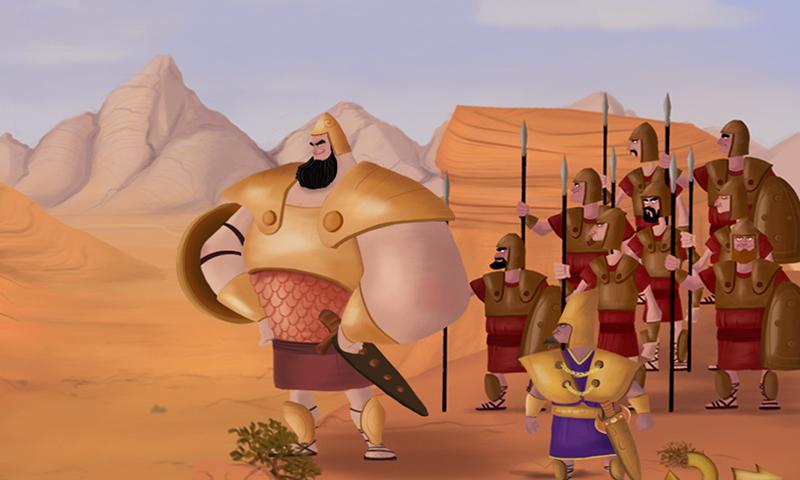
You might have noticed the rather cartoonish image at the top of this page. I picked it because most adults today think of the story in 1 Samuel 17 as a children's story. Like Santa Claus and the Tooth Fairy, we tell kids all kinds of outlandish stories. Some are old wives' tales. Others may have been written initially to make a point. Some of the stories we tell because we hope to instill in our children certain character traits, like courage in the face of danger, not giving up when facing seemingly insurmountable odds, or being prepared in any situation. This kind of thinking reduces the historical accounts in the Bible to mere myths. Instead, we ought to hold these biblical characters out to be heroes of the faith.

In any case, the scene begins when David's father sends him to see how his older brothers are doing. They have joined the army of King Saul, who has engaged in a seeming never-ending battle with the Philistine army. (Side note--the region of Philistia was by the sea, and the term "Philistine" literally meant "Sea Peoples". It is also the root word for the modern term "Palestinians". But I digress.)

David approaches the battle lines, which have been drawn up on opposing ridges overlooking a valley. Neither army seemed to be willing to give up their position on what they saw as the high ground. Eventually, they would probably have come together in the valley, which would have made an excellent battlefield. Saul apparently has lost his nerve, because he has not made the first move. The Philistine army must have sensed that fear, because they were standing on the mountain taunting the Israeli army. It sounded like they were ready to descend into battle, but they sensed that Saul's army was frozen in place. If one side went down into the valley alone, without the other side coming down as well, then the attacking army would literally have an uphill climb. The army that didn't move would literally have the high ground, and thus the advantage.

David heard the taunts, and asked his brothers and their comrades in arms why they didn't go down to engage their opponents in battle. Just about that time, the Philistine champion, a man named Goliath, rose up on the opposing precipice. A huge man, over eight feet tall, with a booming voice. He didn't taunt them. He issued a challenge. Like David, he probably was tired of the taunting, done with words and ready for some action. He said he that Israel should pick a champion, and the two of them would fight to the death. His proposal was that the winner of this epic death match would see the losing side lay down their arms. "If your champion wins," he bellowed, "we will be your servants. However, if I win, you all will be our servants."

Am I the only one who, upon reading this, thought that he was sincere? Maybe the Israelite army, having grown up under the Law of Moses, believed that if they chose a champion who lost to Goliath, then Israel would be enslaved to Philistia. Sizing up the situation, they didn't like the odds. Maybe I am naive, but I always thought that Goliath was proposing the rules of engagement, and that by sending David out to fight him, both parties were agreeing to those terms.

Read further into the story, however, and we see that the Philistine army did not think that way at all. When Goliath fell, they ran. Why would they run? Hadn't they agreed to be servants to the Israelites if he lost? However, "When the Philistines saw that their champion was dead, they fled." (1 Samuel 17:51). Why would they run? Because they thought that the Israelite army would slaughter them. Why would they think that way? Because that was their plan if Goliath had defeated David. All that discussion of disarmament and detente was disinformation designed to dull their senses.

It was all a lie.

How many times do we find ourselves in the same situation? The world tells us to "coexist". We are encouraged to lay aside our Bibles and not be so intolerant, in order to get along with the world. Yet the Muslims still pray six times a day. LGBT folks use the symbolism of a rainbow to appear tolerant, but they still bring lawsuits against a Christian baker who said she would rather not bake them a cake for their gay wedding (while suggesting six other local bakeries where the customer could get exactly what he was asking for.) Atheists ask Christians to ignore a God that they apparently cannot ignore, or they wouldn't be so offended by Him.

Jesus faced a situation much like this. He came to do good. He was literally bringing God to the masses, performing miracles, showing them that God wanted relationship with them, not just religion. The religious leaders of the time, however, did not agree. Look at John 11:47-50:
Therefore the chief priests and the Pharisees convened a council, and were saying, "What are we doing? For this man (Jesus) is performing many signs. If we let Him go on like this, all men will believe in Him, and the Romans will come and take away both our place and our nation." But one of them, Caiaphas, who was high priest that year, said to them, "You know nothing at all, nor do you take into account that it is expedient for you that one man die for the people, and that whole nation not perish."
Caiaphas was hoping that they could betray Jesus to the Romans, and that Jesus would be killed; with that one death, he thought that they could return to the status quo: they would still be in charge, Israel would be intact, even if they were in subjection to the Romans. In essence, he thought that if he threw Jesus down into the battlefield, that He would be extinguished, and that the Romans would see it as the Jews laying down their arms. No insurrection here, no sir! That one fellow, He was kind of a nut. We're glad you guys took care of Him. Now we can go back to offering our sacrifices and forcing the people to follow the Law.

It didn't turn out that way. Jesus wasn't forced to die, He went there voluntarily. He became our sacrifice. Then, when He was resurrected, He became the hope of our salvation. The Jewish leaders were no more--by 70 AD the Roman army killed them all and drove all the Jews out of Jerusalem. The followers of Jesus, however, flourished. They became aware that one Man did have to die for the people, not so the Romans would spare the Jewish leaders and their capitol city, but that the world through Him might be saved.

Saturday, March 4, 2017

Lies the Enemy Tells Us (part 2)


Forbidden Fruit
Nina Simone

Eve and Adam had a garden everything was great
Till one day a boy says pardon Miss my name is snake
See that apple over yonder if you'll take a bite
You and Adam both are bound to have some fun tonight

Go on and eat forbidden fruit
It's mighty sweet forbidden fruit
It's quite a treat forbidden fruit
Go ahead and taste it you don't wanna waste it


The Lord had said in the beginning everything is free
Except that apple that leads to sinning so let that apple be
But Eve got tempted so she tried it and as all chicks do
Teased her man till he decided he'd just try some too

Go on and eat forbidden fruit
It's mighty sweet forbidden fruit
It's quite a treat forbidden fruit
Go ahead and bite it I bet you'd be delighted


I hate to tell you all what followed the Lord was most upset
Saw them making love and hollered "what have you two et?"
And when they made a full confession the Lord said hmm I see
I guess I'll have to teach you a lesson about not minding me

Go on and eat forbidden fruit
It's mighty sweet forbidden fruit
It's quite a treat forbidden fruit
You all went and did it now you gonna get it

The Lord made Eve Adam's madam have his kids and all
Placed some labor laws on Adam and he made the snake to fall
Ever since the days of Eden folks been sinful my
Nowadays they're even eating apples in their pie

Go on and eat forbidden fruit
It's mighty sweet forbidden fruit
It's quite a treat forbidden fruit
Go ahead and taste it you don't wanna waste it
Oh go ahead and bite it I bet you'd be delighted
You all went and did it now you're gonna get it
Forbidden fruit


If you haven't heard Nina Simone's recording of this song, it's quite catchy. I have posted a link to the original recording (sorry bout the ads).  I heard another version on the radio tonight that has a kind of Samba beat (I think).  If you click on the link and listen while reading the text along with the song you might just find yourself tapping your toes or nodding your head to the song. Music has that effect: we get so caught up in the melody that we miss the message.

It's the same with Scripture. We are so used to hearing the Bible stories that our minds wander. We know about the biblical characters, but we forget that it was real life. We gloss over the fact that the decisions these men and women made at that very moment had consequences, both for them and for us several millennia later. 

On my last post I identified 3 lies that Satan literally told Eve, and that Eve presumably passed on to Adam, that made them disobey God. These three little lies plague us even today:
  • You will not die; 
  • You can be like God;
  • You must experience evil to truly know good.
It won't kill you
I won't rehash what I wrote last time, but the gist of it is that if you take the argument that Satan used to its logical conclusion, it is that death with knowledge is better than life with ignorance.  Blind faith is ignorance, and if God demands your obedience, you are missing out on a lot.

God's perspective is much different.  If Man had just obeyed in the first place, we would still be living in Eden, which was literally Heaven on Earth.  If we learn that lesson today, we would know that obedience to God is always preferable to sinful disobedience.  Unfortunately we usually don't see it until it is too late.  A junkie would not be on skid row if he had not taken that first hit.  An alcoholic would not be in jail charged with DUI if she had never taken that first drink.  The family would not be broken by divorce and bankrupt keeping separate households with court-ordered alimony and child support if the couple had been faithful to each other in the first place.  But when the party is in full swing, and everybody says go ahead, it won't hurt you, it'll be fun--it is tempting, isn't it?

We know better
Satan often tempts us by appealing to our minds.  We all have our own biases and opinions; sprinkle in a few facts, and we think we know it all.  All that stuff in the Bible is just kid's stories, or myths, or outright lies.  This is the 21st Century, for God's sake.  We have all this accumulated knowledge about science and stuff, so God didn't create us.  We don't believe that we are created in His image, so we have self-esteem problems that we try to solve by saying drivel like, "You're the best you that you can be."  What does that even mean?

We believe that our morals trump those of Scripture because our culture says so.  We can have sex with anyone we choose, because we have modern birth control methods that work 99% of the time.  And if it doesn't work, we have abortion, so there won't be any pesky kids to remind us of our past indiscretions.  We don't even have to limit our love-making to the opposite sex, because "you can't choose who you love."  Again, what does that even mean?  If that isn't enough, this generation thinks they can choose among dozens of gender models, and self-identify as one or more of them, without ridicule or shame.

What we forget is that we all will die.  When your dead body is on the exam table at the morgue, the Medical Examiner is going to look at your DNA and say you are biologically either a male or female, based on chromosomal evidence that has been present even before you were born.  When you were in your mother's womb, you were biologically identified as one gender or the other.  

When we die, our spirit lives on.  What will we tell our Maker when we meet Him face to face?  "I knew better than you did how to live my life"?  God told the prophet Jeremiah, "Before I formed you in the womb I knew you, and before you were born I consecrated you; I have appointed you a prophet to the nations." (Jeremiah 1:5).  Before a thought even went through your tiny little mind, God knew all about your life, what you would be like, and whether you would choose Him.  King David sang this song to God:  "For You formed my inward parts; You wove me in my mother's womb.  I will give thanks to You, for I am fearfully and wonderfully made." (Psalm 139:13-14).

God knows us.  He knows what is best for us.  All we have to do is trust Him.

How can I know what's right for me if I don't experience it all for myself
Sometimes we accuse God of being unfair.  He made this list of "Thou shalt not's", and we don't even get a say in it.  So we rebel.  We go our own way.  If it works out, great, and if it doesn't, we think we can self-correct.  In the end, we want to be able to say we were in control.

Trouble is, we weren't.  We never were in control.  So many variables are thrown at us, there is no way we can be in control.  We all face a million micro-decisions every minute, and our response is tempered by our education, our family support structure, our finances, our employment status, our culture, our friends, our food choices the day before, our toilet schedule (and whether a clean, sanitary toilet is even available to us), our hunger or thirst at any given moment, the way we feel physically, our emotions, whether there was coffee available that morning, how we slept last night (and with whom), the weather, the traffic, the news--the list goes on and on. And we think we can control any of it?

The Bible says, "Yet  you do not know what your life will be like tomorrow.  You are just a vapor that appears for a little while and then vanishes away." (James 4:14).  We are all ships on a vast ocean, tossed to and fro by the winds and the waves.  We can trim the sails and turn the rudder, but what good will that do in a tsunami?  If we are honest with ourselves, we should admit that we can only control the choices we make, and that we will ultimately be judged by the outcome of those choices.

If God demands an account for our actions, we have no defense.  If we say, "Nobody's perfect," His response is "I AM."  If we say "I did the best I could," He will answer, "I gave you my Word, did you refer to it at all when making your decisions each day"  If we say we had a hard life and we weren't as well off or as protected as Billy Bob or Sue Ellen, he will bring the conversation back to us and ask, "But what about you?  Did I not give you all you needed for life and godliness?  You didn't have to die to know that life was preferable to death, did you? "

We may feel hopeless, but we shouldn't.  God made a way for all of us to find Him.  "All of us like sheep have gone astray, each of us has turned to his own way; but the Lord has caused the iniquity of us all to fall on Him." (Isaiah 53:6).  No matter what you have done, He still loves you.  No matter what choices you have made, he sent His Son to die for you.  Jesus took all of our guilt and shame on Himself, and was punished severely for it.  Because of His sacrificial death and resurrection, we can have a hope for new life, too.  We don't have to go to hell to know it is somewhere we would not want to spend eternity.  I am grateful He made a way for us, if we will follow Him.

Thursday, March 2, 2017

Lies The Enemy Tells Us (part 1)

Image result for art adam and eve with serpent

The serpent said to the woman, "You surely will not die!  For God knows that in the day you eat from it your eyes will be opened, and you will be like God, knowing good and evil." --Genesis 3:4-5

Our culture is a morass of misinformation.  We believe whatever sounds good at the time, or whatever is repeated often enough, or whatever is spoken the loudest.  In time, our cherished beliefs get crushed by reality.  Truth sinks in, usually too late.  Either that, or we die in blissful ignorance.  Either way, there are consequences, in this life or the next.

I believe the Bible warns us of devious deceptions that can ruin our health, our happiness, and our holiness.  We would do well to heed all its warnings.  The Psalmist was right when he said, "Thy word have is a lamp to my feet and a light to my path."  If we walk in the light, we can avoid the pitfalls of the world.  The problem is we enjoy walking in darkness.  It's not necessarily that we are drawn to danger, at least not at first.  It begins when we find that continually being in the light is exhausting:  we must be vigilant, ever alert and watchful, attentive and observant lest we fall, and ever wakeful.  We seek rest and respite, and in our relaxed state we get distracted by what lurks in the shadows.  Our curiosity overcomes us, and we go to take a closer look.  That's when temptation overcomes us, and we fall.  Some of us seek redemption, and look back to the light.  Others hide in the darkness, getting mired deeper and deeper into sin.

God gave the Law to sanctify His people, to keep them separate and holy.  When they messed up, He gave them grace to come back into His presence after repentance and restitution took place.  When Jesus came, He reflected God's redemptive plan by becoming sin for us, and bearing the punishment we deserved.  "For the Law was given through Moses; grace and truth were realized through Jesus Christ." (John 1:17).

I believe you cannot know grace without knowing truth. "For the time will come when they will not endure sound doctrine; but wanting to have their ears tickled, they will accumulate for themselves teachers in accordance to their own desires, and will turn away their ears from the truth and will turn aside to myths." (2 Timothy 4:3-4).  Sadly, our religious culture centers on the grace of God, without giving heed to the truth that sin has consequences.  Yes, Jesus came to forgive, but on more than one occasion, and to more than one person, He also said, "Go, and sin no more."

On the other hand, to preach the wrath of God without preaching the grace of God does a disservice to the hearer.  Guilt and shame may call us to repentance, but without restoration we are still lost in our sins.  This truth is illustrated in the Biblical narrative of Adam and Eve.  

God had created a literal heaven on earth.  Eden was a very beautiful place, a place where God dwelt among men.  He brought all the animals before Adam to see what he would call them--God was engaged with Adam, interested in what he thought, encouraging the man's creativity.  God regularly walked with them in the cool of the evening.  He showed them how to work in the garden He had made for them: how to keep it, cultivate it, and gather a harvest from it.  Yes, God had made it, and it was good, but He was showing them how to make it better still.

Then along came temptation as a serpent.  Satan approached the woman, Eve, and asked her how she liked the garden God had made.  Surrounded by every good thing, she was satisfied.  But Satan asked if God was keeping anything from her.  Had He set limits on what she could enjoy?  Indeed He had--there was one tree from which they were forbidden to eat.  Satan set about making that tree irresistible.  To do that, he had to tell her three lies:
  • You will not die;
  • You can be like God;
  • You must experience evil to truly know good.
It won't kill you.
Some scholars believe that Adam would have lived forever if he had not sinned against God.  I have even heard it said that there were no carnivorous animals in Eden.  Beasts that we know now as predators may have lived on fruit and berries until sin entered the world.  We have no way of knowing how long Adam and Eve lived in the garden, in the presence of God, before the Fall.  It could have been months, or it could have been years.  I believe that as long as they lived there, no living creature experienced death.

Let me just say here that I believe in a literal six-day creation.  I believe the Biblical story here is true.  If you believe it is an allegory, you must admit that it loses some of its meaning.  For example, if you believe that God did not create the world in six days, but instead set everything up for life to evolve on its own for twelve billion years or so, then the idea of God becoming engaged with His creation loses a bit of its luster.  I mean, if God was present at the Big Bang, then went off somewhere and cooled His heels for a few billion years before coming back to check on things, at what point can we say that we are created in His image?  If that Scripture is not true, then what other parts of the Bible must we ignore as not trustworthy?  And most important, if man simply evolved from lower life forms, why would God come in the form of a man to become the supreme sacrifice for us?  Why go to the trouble of redeeming us unto Himself if He could just allow us to obliterate ourselves off the planet for our sins?  Wouldn't the Earth repopulate itself through the same evolutionary process?  There is a lot of theology that becomes meaningless if God did not create us.

In any case, there was no death until Satan introduced it via sin.  When Eve tried to argue with the serpent, she said something she did not fully understand: "We must not eat of it, nor touch it, lest we die."  Satan used that to his advantage.  With her naivete, Satan was able to convince her that death is better than life.  You and I have the advantage of experience--we have seen enough people die to know that life is preferable.  She only had her trust in God to keep her obedient.  If God said death would result from disobedience, then He should know what He was talking about.  Satan invited her to test the waters, to see whether disobedience was better than obedience, whether the God she knew was better than the god she could become (if the serpent's message was to be believed).  He tempted her to see if in fact life was better than death.

We know now that it was all a lie.  Life is better than death.  The God of the Universe is greater than the gods we purport to be.  Obedience is indeed better than disobedience.  We know from experience.  Adam and his wife Eve didn't know from experience, but they knew what God had told them.  If they had kept strong in their faith in God, then sin and death would not have been allowed in.  Losing faith in God demanded that death and other consequences must be enforced.  God had spoken; there was no other way.

Thursday, September 15, 2016

This I know: that God is for me


Image result for images psalm 56:8

When I am afraid, I will put my trust in you. --Psalm 56:3
When you think of a gift registry, you usually think of baby showers or bridal shows.  More recently, however, those with more practical sensibilities are able to find gift registries at hardware stores and home improvement warehouses.  The thinking is that in setting up a home, you need more than candles and throw pillows, more than dishes and cookware.  You may need some light fixtures or ceiling fans to renovate your new home.  You may even need some basic tools--items you may not be able to borrow from Dad any more.

In Psalm 56, David seems to indicate that God has an even more basic registry:  He registers our tears.  He keeps account of every one.  They are written in a book.  I imagine that there are as many categories in His tear registry as there are reasons to cry.  Tears for mourning.  Tears of joy.  Tears of sorrow.  Tears of remorse.  The list goes on and on, yet God knows the reason for each one.  Verse eight says He collects them in a bottle, or a skin (before glass was in wide use, people would keep water or other liquids in animal skins, sewn together with an opening like a canteen.  You may recall Jesus making an allegory about wineskins--same thing.)

Several Bible translations change the wording in the beginning of the verse to correspond with their interpretation of the latter part.  Instead of "wanderings", they substitute the term "Sorrows" or "Misery", as if that is the only reason people shed tears.  Other translations use the word "tossings", as if one is having a nightmare or maybe losing sleep.  According to Strong's Concordance, however, the correct word is "wanderings", as in wandering in exile, or the nomadic wanderings of a fugitive.

In context, David is speaking of the trials and tribulations he suffered before he became king of Israel. He began as a shepherd, wanding the hills of Judea looking for pastureland.  He was anointed by Samuel, yet was hunted relentlessly by Saul, who wanted to kill him.  David and his men lived in caves, hid in the mountains, and even crossed the border into Philistine territory.  His exile before reaching his destiny on the throne is a pre-cursor to the ministry of Jesus, who lived in a kind of exile from the Pharisees who sought his life.  And it could apply to us, as we are pilgrims in a land not ours, seeking heaven's shores.

In a broader sense, the term "wanderings" conjures images of the children of Israel, whom Moses brought out of Egypt.  Because of their lack of faith, God let them wander in the wilderness for forty years--an entire generation--before allowing them into the Promised Land.

More specific to my life, I sometimes feel like I am wandering aimlessly about, wondering why God has not given clearer direction.  There are some times I can identify with the parable of the Prodigal Son; in that case, my wandering is of my own doing, having nothing to do with God or His will for my life.  You may have your own ideas of what the word "wanderings" means to you.  

Through it all, God is keeping track.  According to Psalm 56:8, He keeps an account of our wanderings, whether we are faithful to Him or not.  He collects our tears, and catalogs them in a book.  He is intimately aware of our comings and goings, of our thoughts and emotions, of our joys and fears.  See, many of us have an idea that God is transcendent; that is, He is far away looking down on us from heaven's lofty heights.  If heaven is a physical place, it is in a parallel universe that is inaccessible to us.  If heaven is inaccessible, then so is God.

When Jesus taught His disciples to pray, note what He said:  "When you pray, pray like this: Our Father who is in heaven."  The word He used for "Father" is Abba, a very intimate word for "Daddy".  It is the first word spoken by many children in countries that still speak Hebrew or Arabic.  That familiarity, that closeness, is what theologians mean when they say God is imanent.  He is here, He is with us, He is for us.  At the same time, yes, He is in Heaven, transcendent and apart from us in holiness and majesty.  He is both.

That is why, I think, that David wrote in verse 9, "This I know, that God is for me."  If He is transcendent (and He is)--far above us, holy, unapproachable in splendor--yet takes the time to know us so intimately as to keep a catalog of our tears, registered in a book so that when we do arrive in our heavenly home He comforts us with a comfort that is tailored to our specific profile that no one else knows about us, then that says a great deal about Him.  Think about it.  No one knows us like the One who made us.

Revelation 7:17 gives us this promise:  "For the Lamb in the center of the throne will be their shepheard, and will guide them to springs of the water of life; and God will wipe every tear from their eyes."


Monday, September 5, 2016

It's All About Relationship

Image result for images broken people

A thief must certainly make restitution, but if he has nothing, he must be sold to pay for his theft.  --Exodus22:3(b)
A few weeks ago I was listening to a radio essay on NPR about one particular community and how they deal with folks with mental disabilities.  Legend has it that a young woman name Dymphna fled to a small town in Belgium called Geel to escape the advances of her father, an Irish king who had gone insane after his wife, Dymphna's mother, died.  The king ascertained her whereabouts, and travelled to Belgium to retreive her.  When she refused to return with him, she was martyred.

Building upon this legend, a church was built in Geel in the mid-14th century to honor Saint Dymphna.  By the late 15th century, so many pilgrims were coming to Geel from all over Europe to seek treatment for the mentally ill that the church ran out of room to house them all.  The townspeople began taking them into their own homes, starting a tradition that continues to this day.

Now, none of these townspeople have studied medicine.  They are not trying to "heal" the mentally unstable people who come to live with them.  Their culture is to simply accommodate them.  When a person who has been labeled "insane" in another part of the world comes to Geel, the town elders meet together to decide which family will house them.  The family is not told of their condition; they simply open their home to a complete stranger, and try to make them feel at home.

One woman was interviewed whose house-guest would obsessively twist off all of the buttons on his shirt each day.  The woman would faithfully sew the buttons on each night for the man, knowing full well that she would have to do it again the next day.  The interviewer asked why don't you give him a pullover shirt, or why not use fishing line to sew the buttons back on (so it would be  harder to twist off).  The woman shook her head and said, "No.  That would be a disservice to the man.  You see, he needs to twist off his buttons each day.  That is why I sew them back on for him each night."

A man was interviewed whose house-guest would frequently make inappropriate advances toward his wife.  When that happened, the man would grasp the young ward by the back of the neck and guide him outside.  "That is my wife," he would say.  "You need to find your own woman."  It turns out that the young ward met a young woman at a mixer organized by the town council.  They began dating, and the young man no longer makes untoward advances to his house-mother.  Because of this older couple's guidance, the "broken" man found love with a "broken" woman, who was the house-guest of another family.

Several have tried to export the Geel model to other cities.  One Harvard grad student, after travelling to Geel to study the culture there, went back and asked for an educational grant to study the Geel model and try to replicate it in the United States.  Her application for the grant was denied, and her advisor told her that in the US, the culture is so different--here, it is all about "fixing" people.  Millions are spent on treatments and medications to moderate the symptoms of mental illness, with the result that the expectation is for them to get better.  In all of our effort to make them well, according to this Harvard professor, we would not accept a paradigm shift of accommodating the insane, as they have been doing in Geel for over 600 years.  By contrast, American culture is to fix them, and if they cannot be fixed, then we send them away to an institution, where they are restrained, controlled, and anesthetized into a stupor so they won't be a burden to society.  That is our expectation.

We cannot abide broken people, because we, ourselves, are broken.

Last week I heard a sermon about submitting as a servant or slave to God.  When we think of slavery, we think of abuses--of subjugation, of forced labor, of life-long ownership.  However, when God gave His law to His people, he set up rules for bond-servants, which had to be followed to the letter.  First off, a slave was not to be owned for the rest of his life.  "If you buy a Hebrew servant, he is to serve you for six years.  But in the seventh yeart, he shall go free, without paying anything." (Exodus 21:2).  There were also rules about humane treatment, payment for services, etc. that made the Hebrew idea of indentured servitude very different from our ideas of slavery.

So how would a member of a God-chosen race of Hebrews find himself sold into slavery?  It was not by being captured or overrun by a neighboring Hebrew tribe.  Most often it was his own doing, either by incurring a debt he could not repay, or by being caught in a crime.  "If a man steals an ox or a sheep and slaughters it or sells it, he must pay back five head of cattle for the ox and four sheep for the sheep." (Exodus 22:1).  In our civil justice system, the very worst judgment that can be made against you is treble damages, or three times the value of the loss.  In ancient Hebrew times, it was quadruple or even quintuple damages.

Imagine for a moment, if you will, that you are an ancient Hebrew.  You are not rich by any means, but you have a small lot to farm, and a yoke of oxen with which to plow.  You have some sheep and chickens, and you trade some milk and eggs and wool for things that you cannot make at home like shoes or building supplies for your house and shed.  One morning you wake up and find one of your oxen missing.  You ask around, and find that someone stole it and took it to the local butcher.  The butcher identifies who brought the animal in, and you take him to the Judge.  Under the law, the judge says that the thief must make restitution: five oxen for the ox that was taken.  Unfortunately, the theif is so poor he cannot pay the fine.  The judge asks you if you want him to work off the debt on your own farm, or whether you want him sold for the price of five oxen.  You decide that he can work for you, that he would not need to be sold--you still have an ox in your stable, and you can make do for now.

According to the law, once the servant has earned enough to pay off the price of the five oxen, he is free to go, with the maximum time of six years.  Now most of us do not own livestock, so we have no idea how much one ox costs, much less five.  Think instead about the car you drive.  My older SUV is worth about $3000; my wife's car is worth about $13,000.  Minimum wage is about $300 per week, or about $15,600 per year.  If the perp stole my car, he would have worked off the debt in one year.  If  he stole my wife's car, it would take a little over 4 and a half years to pay it off.  Maybe your car is more of a luxury car than we drive, and it would take over 6 years to pay it off.  You would have to let him go in the 7th year under the law.

If you are still awake after all the applied mathematics, I want you to think about having the thief as your employee.  If you were the scratch farmer who lost the ox, you might want him to clear some land adjacent to your field, so you could increase your yield and buy a new ox.  You wouldn't want to leave him alone, however--he is a thief, after all.  You would probably be there working with him, both to keep him honest, and also to make sure the trees are felled and stripped, and loaded onto your wagon.  You plan to sell the trees to the sawmill for money to buy extra seed.  The seed will be sown in the expanded field, and by harvest time, God willing, you will reap a bountiful harvest.

As you are working with your indentured servant, you start telling him about these plans.  You model for him how hard work and planning can pay off, with God's help.  The servant finally opens up to you, and tells you about his family--maybe how he was orphaned at age 13, with many younger brothers and sisters to feed.  You hear how this 13-year old (an adult, by ancient Hebrew standards) was able to continue his father's business, but within four years the business went bankrupt.  You learn that his siblings were sent to the neighbor's fields each autumn to harvest the "gleanings" (another ancient Hebrew practice for taking care of the poor and indigent), but that his younger sister became ill and it took all they had to care for her.  You let him take some of his wages home with him, to give to his siblings for their needs.  You see that he is a hard worker, and by the time his debt to you is paid off, you offer to keep him on as a hired hand, at double the wages (because he is no longer paying you for the oxen); or you may know of another land owner for whom the young man can work, and maybe even apprentice for and learn a trade from.

Do you see what just happened there?  A relationship was built all because of the Law that had been broken.  A life was changed due to the payment of a debt.  A hope and a future was given to a man who had hit rock bottom.

Isn't that what Jesus did for us?  He came to build a relationship with us, because there is no way we could keep the Law by ourselves.  He paid the debt for us, and our lives have been changed forever.  We now have a hope and a future--we were not sent to some prison; we were not forced into an asylum for the criminally insane.  Those places would not have helped us.  God has given us a better way.  "I know the plans I have for you, declares the Lord, plans for welfare and not for calamity, to give you a future and a hope." (Jeremiah 29:11).

I don't do relationships very well.  I am broken.  Thank God I  have someone willing to take me into His house and sew on my buttons, even when I twist them off each day.  Praise Him that He has made a way to pay my debt, and to offer me a welfare plan that is far and away better than that offered by any country on earth.  Because of His generous acts toward me, I can pay the blessings forward to other broken people.  I may not know their whole story, but I do know that God decided to have them cross paths with me for a reason.

Thursday, August 18, 2016

He is able to deliver you

Image result for romans 7:24-25

And so all Israel will be saved; just as it is written, "The DELIVERER will come from Zion, He will remove ungodliness from Jacob.  This is my covenant with them, when I take away their sins."  --Romans 11:26-27
Hello, my name is Blynn.  I am a sinner.  It has been 25 days since I have "thrown off the sin which so easily entangles" me.  Not that I am sinless perfection.  Far from it.  But there is one particular sin that has hung like an albatross around my neck for 40 years.

No more.

I am done with wandering in the wilderness, and by God's grace I will follow Him into the Promised Land.  I know it will not be easy--Joshua and the Israelites had to physically fight to remove the heathen from the land.  Even then, they had to be on guard:
"Then it shall come about when the LORD your God brings you into the land which He swore to your fathers, Abraham, Isaac and Jacob, to give you, great and splendid cities which you did not build, and houses full of all good things which you did not fill, and hewn cisterns which you did not dig, vineyards and olive trees which you did not plant, and you eat and are satisfied, then watch yourself, that you do not forget the LORD who brought you from the land of Egypt, out of the house of slavery." --Deuteronomy 6:10-12
Jesus Himself said, "If anyone wishes to come after me, he must deny himself, and take up his cross DAILY, and follow Me."  (Luke 9:23).  The cross is not a burden we bear.  It is an instrument of death.  We must put to death the flesh, because "with my flesh I serve the law of sin." (Romans 7:25b).

Today I woke up with the words to an old hymn on my mind.  I had forgotten some of the text, so I had to look it up.  The refrain goes like this:
He is able to deliver thee,
He is able to deliver thee;
Though by sin oppressed, go to Him for rest;
“Our God is able to deliver thee.” 
If you did not grow up in a hymn-singing church, you can read the text without humming the tune.  I have to stop myself from humming it, because the music can get in the way of the message.  The promise is right there--Our God IS able; HE is able; He is ABLE to deliver me.   Even when I feel opressed by my sin, God alone can deliver me.

Yesterday I was reading Psalm 118.  It is a psalm of deliverance.  "From my distress I called upon the Lord," it says.  "The Lord answered me and set me in a large place." (verse 5).  The Hebrew word for "setting me in a large place" is merchâb (pronounced "mer-khawb") and it means enlargement, either literally (an open space, usually in a good sense), or figuratively (i.e. liberty)--breadth; large place or room.  Close your eyes and imagine yourself in a huge warehouse; not one filled to the rafters with stuff, but wide open.  You are not feeling hemmed in by anything.  You are not alone, either.  It's just you and God in this large room or sanctuary.  Isn't that a good feeling?  "It is better to take refuge in the Lord than to trust in man." (verse 8).  In my meditation on this verse, I added, "or women; or my favorite sin."  You can insert whatever oppresses you.
All nations surrounded me; in the Name of the Lord I will surely cut them off.  They surrounded me, yes, they surrounded me; in the Name of the Lord I will surely cut them off.  They surrounded me like bees; they were extinguished as a fire of thorns; in the Name of the Lord I will surely cut them off.  (Psalm 118:10-12)
Do you see the repeated phrase there?  This is how you defeat sin in your life.  In the Name of the Lord, you cut them off.  You can't do it in your own power; only in the Name of the Lord.  If you cut them off, they no longer have any power over you.  Many of you may have battled alcoholism.  When you were under the influence, the last thing you wanted to hear was that you were cut off.  By contrast, now (hopefully) you have taken the place of the bartender or friend who stepped up to keep you from having that next drink.  In the Name of the Lord, you are able to cut off the effects of alcohol by skipping that first drink.

It's not easy.  You have to take it one day at a time.  You have to remind yourself of when you last gave in.  You may be 25 days, 25 weeks, 25 months or 25 years into sobriety, but you still have to crucify the flesh daily.  However, there is good news.  "He is able to deliver you."

As an aside, some of my older friends make fun of the more contemporary worship services and the choruses they sing.  To some, it seems like the choruses are overly repetitious.  "Those songs are just seven-eleven songs--you sing seven words, but repeat them eleven times."  I chuckled when I looked up the hymn that God had given me this morning.  It repeats the same thought over and over as well, to drive home the point.
’Tis the grandest theme through the ages rung;
’Tis the grandest theme for a mortal tongue;
’Tis the grandest theme that the world e’er sung,
“Our God is able to deliver thee.”
Refrain:
He is able to deliver thee,
He is able to deliver thee;
Though by sin oppressed, go to Him for rest;
“Our God is able to deliver thee.”
’Tis the grandest theme in the earth or main;
’Tis the grandest theme for a mortal strain;
’Tis the grandest theme, tell the world again,
“Our God is able to deliver thee.”
’Tis the grandest theme, let the tidings roll,
To the guilty heart, to the sinful soul;
Look to God in faith, He will make thee whole,
“Our God is able to deliver thee.”
 I know.  By now you are rolling your eyes.  How can anyone complain about modern Chrisitan music being repetitious when this hymn keeps repeating the same phrase.  Over. And. Over. Again.  But I want you to look at the last verse.  If you are opressed by sin, if it seems like a swarm of bees has surrounded you and is closing in all around you--remember that through faith, in the Name of the Lord,  you can cut off the enemy and find liberty and freedom in Christ.

Thursday, August 11, 2016

Never, ever give up.


Rejoice always; pray without ceasing;give thanks in all circumstances; for this is the will of God in Christ Jesus concerning you.  1 Thessalonians 5:16-18
So what do you do when you've screwed up?  You know it.  God knows it.  Your spouse knows it.  In your shame and grief, you feel like everyone is judging you.  If your daughter is quiet, you think she is not talking to you because of your guilt.  If you go to church, you feel like you can't participate in theological discussions or public prayers because of your sin.

In these cases, I think it is important to remember the words of that great theologian, Winston Churchill:  "Never give in--never, never, never, never, in nothing great or small, large or petty, never give in except to convictions of honor and good sense.  Never yield to force; never yield to the apparently overwhelming might of the enemy."

This week I read 2 Samuel chapter 24.  You should stop what you are doing and read it now.  Go on, we'll wait.  To recap, King David decided to take a census of all the men of fighting age within the kingdom of Israel.  Joab, the commander of his armies, thought it was a bad idea.  So did the other military leaders.  Nevertheless, David commanded that it should be done, and it was.  Then God convicted him of his sin.

"David was conscience-stricken after he had counted the fighting men, and he said to the Lord, 'I have sinned greatly in what I have done.  Now, O Lord, I beg you, take away the guilt of your servant.  I have done a very foolish thing."  (2 Samuel 24:10).  A prophet was sent to give David a choice: God could send three years of famine, or three months of fleeing from his enemies, or three days of plague.  David, trying to be a wise ruler, did not want to subject the people to too long a punishment.  So God sent a plague all across Israel, and 70,000 people died.

The angel of death sent by God was stopped by God before he reached Jerusalem, because David prayed, "I am the one who has sinned and done wrong.  These are but sheep.  What have they done?  Let your hand fall upon me and my family." (2 Samuel 24:17).  God instructed David to go to a certain place and offer a sacrifice.  David complied, and offered to buy the land and the altar from the man who owned it.  The man demurred, saying that as King, David could take whatever he wanted for whatever use he wanted to do with it.  David's response was, "I will not offer to the Lord that which cost me nothing."

Lessons from this passage that speak to my heart:

It is a sin to trust in our own power, instead of trusting in God.  David wanted to take stock of his fighting men so he could know his strength as a warrior king.  God had already promised Moses, "The Lord will fight for you; you need only to be still."  Almost any sin that we can think of can be traced back to a lack of trust in God. When Jesus said, "Pray this way...give us this day our daily bread," He was not talking just about food; our God is able to meet all your needs according to His riches in Glory in Christ Jesus.

Your sin affects other people.  David knew that famine, war, and plague would all take a toll on the people he loved.  I don't think he realized the extent to which the consequences would affect the nation.  Losing 70,000 countrymen in just 3 days had to be overwhelming.  In the same way, we don't think about how badly our friends and family might be hurt from our own personal sins.  Even when we take full responsibility for our failures, people still will get hurt.

Do not give up on God or on godliness.  When David prayed, he spared the lives of countless Israelites living in Jerusalem.  Who knows whether his praying sooner might have stopped the deaths of some of the 70,000 who lost their lives in the plague?  What we do know is that we should not shy away from our faith.  Pray.  Fast.  Repent.  Seek God's face.  He will reward your faithfulness.  He will show grace, even in the midst of the consequences.  I think in the Church today we put too much emphasis on grace and not enough on justice.  We must remember that God is holy, and that for us to approach Him we must sanctify ourselves, putting aside our sinfulness to the extent that we are able. "If I had cherished sin in my heart, the Lord would not have heard me." (Psalm 66:18).

Be willing to give what God asks.  Jesus said anyone who puts his hand to the plow and looks back is not worthy of the kingdom.  Like David, we do not trust God enough to give away what He asks us to give away.  It is a sin to hold on to anything that stands between you and God.  We must remember that obedience to God is worth more than riches or fame or anything else.  Most of the time God will reward faithfulness and obedience, and His reward will be worth far more than whatever we gave up to get right with Him.  

My local professional baseball team, the Texas Rangers, are doing very well this year.  In Spring Training, their 2nd year manager emphasized one thing in the clubhouse: Never, Ever Give Up.  Needless to say, the team culture is better for it.