Translate

Saturday, April 24, 2021

Money can't buy happiness--or eternal life

 Pin on Mark - English and Thai Script

Whoever trusts in riches will fall, but the righteous will flourish like a green leaf.  --Proverbs 11:28

The Wizard of Id was a daily newspaper comic strip created by Brant Parker and Johnny Hart in 1964 to satirize modern American culture and politics.  One entry published in 1967 shows the squat King giving a speech from the balcony of his castle.  "Remember the Golden Rule," he says.  One of the peasants down below asks, "What's that?"  Another peasant answers snidely, "Whoever has the gold makes the rules."

It's easy to view all human interaction in economic terms.  To get what you want, you must give someone else something that they lack, and vice versa.  I give my labor or my time and expertise to my employer in exchange for a paycheck; my employer utilizes the labor or talents of their employees to create or distribute goods and services, which they sell for a profit.  The worker trades his paycheck for other goods and services, such as housing, food, clothing, transportation and entertainment.

With the accumulation of wealth comes a desire to protect that wealth, to keep it from being lost or stolen but also to be invested wisely so that the things on which it is spent add value.  "For where your treasure is, there your heart will be also." (Matthew 6:21).  I think it is important to keep this in mind when reading the Bible passage commonly called the Rich Young Ruler.

Now as He (Jesus) was going out on the road, one came running, knelt before Him, and asked Him, "Good Teacher, what shall I do that I may inherit eternal life?" --Mark 10:17

This man, whom we find out later is a man of means, asks Jesus what it would take for him to make heaven.  What one thing would he have to do, or build, or produce, or perform to get to heaven?  In other words, what would it cost him?  Again, he was rich, so he was thinking in economic terms.  Unfortunately, many people today also test God in this way, thinking that the more good works we do, the closer we will come to attaining heaven.  Sadly, there are even Christian denominations that teach one must do a number of works to either attain or keep salvation.

So Jesus said to him, "Why do you call Me good?  No one is good but One, that is God.  You know the commandments: 'Do not commit adultery,' 'Do not murder,' 'Do not steal,' "Do not bear false witness,' 'Do not defraud,' 'Honor your father and mother.' "  And he answered and said to Him, "Teacher, all these things I have kept from my youth."  --Mark 10:18-20

It may seem like Jesus gets short with this man, much like He did with the Syrophoenician woman in Mark 7:24-30.  The mental whiplash we, the readers, experience may just be Jesus redirecting the narrative.  Instead of speaking in economic terms (what do I have that I can trade for eternal life?), Jesus focuses the discussion on morality and religion.  Jesus noted that the man had called Him good.  Defining the word "good" as sinless or perfect, Jesus noted that only God is good--that is, only God can keep the entire Law.  It is worth pointing out that Jesus did fulfill the Law, therefore He is God.  This point may have been lost on the poor little rich man; he didn't realize who he was talking to.  

The man, speaking in moralistic, relativistic terms: he was a "pretty good guy."  He may not have killed anyone, or stolen anything, or committed adultery.  He didn't make a habit of lying or of dishonoring his parents.  Like us, he thought of himself as a decent person, so what else did he need?  Why was there still something missing in his life?  

Then Jesus, looking at him, loved him, and said to him, "One thing you lack: Go your way, sell whatever you have and give to the poor, and you will have treasure in heaven; and come, take up your cross, and follow Me."  But he was sad at this word, and went away sorrowful, for he had great possessions.  --Mark 10:21-22

Please note the love that Jesus had for the man.  This is what the man lacked.  This poor fellow loved his possessions more than he loved Jesus.  This was not a call for all Christians to take a vow of poverty.  It was a call to give up anything that we may love more than Him.  Wealth was his hang-up.  Yours may be a certain relationship.  Jesus addresses this later in this passage.  Mine may be a sin that makes me look back like Lot's wife.  Thank God for grace.  Thank God for the love Jesus.

Then Jesus looked around and said to His disciples, "How hard it is for those who have riches to enter the kingdom of God!"  And the disciples were astonished at His words.  But Jesus answered again and said to them, "Children, how hard it is for those who trust in riches to enter the kingdom of God!  It is easier for a camel to go through the eye of a needle than for a rich man to enter the kingdom of God."  And they were greatly astonished, saying among themselves, "Who then can be saved?"  But Jesus looked at them and said, "With men it is impossible, but not with God; for with God all things are possible."  --Mark 10:23-27

The disciples asked a good question: Who can be saved if we have nothing to offer God?  If a rich man can't get to heaven without giving up all his riches, what do poor people have to give up?  I think this is why Jesus repeated the warning, so that He could include the caveat including the word "trust".  It is difficult for us to give up anything we trust in.  Or put another way, we must not trust anything more than we trust God.  Impossible, you say?  Not for God.

Then Peter began to say to Him, "See, we have left all and followed You."  So Jesus answered and said, "Assuredly, I say to you, there is no one who has left house or brothers or sisters or father or mother or wife or children or lands, for My sake and the gospel's, who shall not receive a hundredfold now in this time--houses and brothers and sisters and mothers and children and lands, with persecutions--and in the age to come, eternal life.  But many who are first will be last, and the last first."  --Mark 10:28-31

Peter, the most vocal disciple, tries to distance himself from the rich young ruler and justify himself by pointing out that he, a humble fisherman, left everything to follow Jesus.  That has to count for something, right?  Jesus rightly points out that if you give up family for the Family of God, you gain multiples of brothers and sisters, father figures and mothering types.  You will also have access to the Church's resources to meet your needs; conversely, if someone in the church has a need and you are blessed with more than you need, then you can help meet their needs.  Along with this wealth of family, friends and other things also comes persecution.  This is something that the "health and wealth gospel" proponents forget to mention.  Nowhere in Scripture does it say to name and claim your mansion, your promotion at work, your new car or boat, or your jet airplane.  It does say that your needs will be met.  It does say that there will be persecution.  It also does say that you will have eternal life in the age to come.

Those who seem to be blessed in this life, who have obtained wealth, may be looked up to in this world.  In the age to come, however, they will be last.  Those who have suffered the most in this life, whom the world looks down upon here, will be rewarded the most in heaven.  Instead of seeing things from the world's perspective, we must look at it from God's perspective, where a camel can go through the eye of a needle, and a sinful man can go to heaven by God's grace.


Saturday, April 17, 2021

Jesus, touch my life--and my kids

 The Chosen - "Jesus Loves the Little Children" | Facebook

Too often we underestimate the power of a touch, a smile, a kind word, a listening ear, an honest compliment, or the smallest act of caring, all of which have the potential to turn a life around.  --Leo Buscaglia

My wife and I have fallen in love with the television series The Chosen, the first multi-season series on the life of Christ.  It is a crowd-funded project created, directed and co-written by American filmmaker Dallas Jenkins.  The pilot first aired December 24, 2017.  My wife's favorite episode is season 1 episode 3, which originally aired April 21, 2019, because in it Jesus attracts a group of children to Himself, and begins teaching them the Gospel.  The words that Jesus spoke to the children in this TV drama were taught to the disciples in the New Testament books of Matthew, Mark, and Luke, but the simplicity of the gospel message is such that even a child can understand. 

The people whom Jesus touched were truly blessed by Him, and many wanted their families to be touched by Him as well.  This is where we take up our passage in Mark 10:13-16:

And they were bringing children to Him that He might touch them, and the disciples rebuked them.  But when Jesus saw it, He was indignant and said to them, "Let the children come to me; do not hinder them, for to such belongs the kingdom of God.  Truly, I say to you, whoever does not receive the kingdom of God like a child shall not enter it."  And He took them in His arms and blessed them, laying His hand on them.

Perhaps the disciples thought that Jesus was much too busy with adult problems and logistical challenges to minister to the children.  Maybe they thought that the time spent by an important Rabbi or spiritual teacher would be wasted on children.  After all, children were too young to understand the spiritual concepts of Original Sin, Sacrificial Atonement, and Righteousness through Justification.  Still the children were drawn to Him, and He accepted them with open arms.

How young is too young to confess and believe in Jesus?  I was seven.  My parents took me to church regularly, and I felt the prodding of the Holy Spirit to respond to the invitation given by the pastor at the end of the service.  My father took my hand, walked me to the altar, and led me in the Sinner's Prayer.  While there is nothing magical about the words, the fact is that I trusted Jesus for my salvation on that very day.  Did I have some heinous sin that I needed to repent of?  No, of course not.  Was my understanding of theology fully mature?  By no means.  Did I feel the stirrings of the Holy Spirit within my heart, and desire to come to God through His Son at that early age?  Absolutely.

Jesus directed the disciples to allow the children to come to Him, not to rebuke them.  He gathered them in His arms and blessed them, laying His hands on each of them.  If you work with children, you know that they like attention.  Jesus directed His full attention to them.  He may have listened to their rambling stories and smiled when they offered Him a flower or a small stone as a present.  The scripture says that the parents brought the children so He could touch them; He did so much more.

In the early 1960s, Christian singer/songwriter Bill Gaither was travelling with Dr. Dale Oldham in his evangelistic crusades.  One day in 1963, Oldham told Gaither, "Bill, the word 'touch' is a very popular word.  It comes up so often in the New Testament stories about Jesus touching people's eyes and healing them, or touching people's lives and changing them.  It's a special, spiritual word and you ought to write a song that praises His touch."  The song He Touched Me was written that week, and first sung by Dr. Oldham's son Doug.  It went on to be recorded by The Blackwood Brothers, Jimmy Durante, Elvis Presley, was featured on the Lawrence Welk Show, and was sung in countless churches and tent revivals for decades.

Throughout the course of our exegetical study of the Gospel of Mark over the last several months, we have seen how the touch of Jesus was powerful, loving, healing, and forgiving.  In Mark 1:41, a man with leprosy approached Him, saying, "If you will, you can make me clean."  Defying Old Testament tradition and the prevailing health standards of the day, Jesus touched the man, saying "I will.  Be clean."  In Mark 7:33 a deaf/mute was brought to Jesus, and He drew the man aside, away from the crowd, and touched his ears and his tongue (that's much more than many of us would ever do!).  In Mark 8:22 some people brought a blind man to Jesus and begged Him to touch their friend.  Jesus led the man away, and laid His hands on him, not once but twice, until the man's need was fully met.

You see, touching someone is more than poking a finger at them.  Jesus engaged the people He touched--He spent time with them, listened to them, put his hands on them.  See, He didn't just touch them physically; He touched them on an emotional, almost visceral level.  After a touch from Jesus, one would be completely changed.  He or she would have a heart of flesh where there was once a heart of stone. (See Ezekiel 36:26)

He Touched Me

Shackled by a heavy burden,
'Neath a load of guilt and shame.
Then the hand of Jesus touched me,
And now I am no longer the same.
He touched me, Oh He touched me,
And oh the joy that floods my soul!
Something happened and now I know,
He touched me and made me whole.
Since I met this blessed Savior,
Since He cleansed and made me whole,
I will never cease to praise Him,
I'll shout it while eternity rolls.
He touched me, Oh He touched me,
And oh the joy that floods my soul!
Something happened and now I know
He touched me and made me whole.

Sunday, April 11, 2021

The D Word

 Dealing With Divorce Through Humor

There's no pain or failure quite like going through a divorce.  --Jennifer Lopez

One of the hard things about going through a verse-by-verse study of Scripture is when you find a passage denouncing a sin of which you, the writer, are guilty.  When sin is brought to light, then the appropriate response is to confess, repent, and learn from the experience.

Our passage today deals with the sin of divorce.  In the spirit of transparency, I have been divorced...more than once.  I am neither proud of the choices I made that led to those breakups, nor do I recommend that path for others.  However, as therapeutic as this blog is for me, I do not want to make this about me.  Let's instead turn our attention to the Scripture, and see what it says.

And He (Jesus) left there and went to the region of Judea and beyond the Jordan, and crowds gathered to Him again.  And again, as was His custom, He taught them.  And Pharisees came up and in order to test Him asked, "Is it lawful for a man to divorce his wife?"  He answered them, "What did Moses command you?"  They said, "Moses allowed a man to write a certificate of divorce and to send her away."  And Jesus said to them, "Because of your hardness of heart he wrote you this commandment.  But from the beginning of creation 'God made them male and female.  Therefore a man shall leave his father and mother and hold fast to his wife, and the two shall become one flesh.'  So they are no longer two but one flesh.  What therefore God has joined together, let not man separate."  And in the house the disciples asked again about this matter.  And He said to them, "Whoever divorces his wife and marries another commits adultery against her, and if she divorces her husband and marries another, she commits adultery."  --Mark 10:1-12

Doubtless some of the Pharisees who challenged Jesus about this subject had been divorced themselves.  There is some evidence that the Apostle Paul, writer of one half of the books in the New Testament, may have been divorced (or widowed).  We know that before he was converted, Paul had been a Pharisee (Acts 23:6).  Yet later in his ministry, Paul advised single (unmarried) people to stay single, as he was (1 Corinthians 7:10-14).  Looking at Mark 10:10, I wonder whether one or more of the disciples were divorced; otherwise, why would they pursue this matter further, after Jesus had taught them plainly?

The point is that people are sinful, and even Christ-followers will fall short.  And in this case even the Pharisees were not testing the morality of Jesus, but testing to see whether He sided with one of the two major Jewish teachers of the day.  One camp, led by Rabbi Shammai, held that a man may only divorce his wife for serious transgressions.  The other side, led by Rabbi Hillel, allowed for divorce for the most trivial of matters, such as burning a meal.  The parallel passage in Matthew 19 reveals their true mind-set--not only had the Mosaic law allowed for divorce, but in their minds it was so common that a command was issued.  "Why then did Moses command one to give a certificate of divorce and to send her away?" (Matthew 19:7).

Jesus gently corrected them.  His question to them of "What did Moses say" may have been more of "Did Moses really command you to give a certificate of divorce?" Their answer in Mark 10:4 was a correction.  "Moses allowed a man to give a certificate of divorce and put her away."  Yet even their concept of divorce was flawed.  The Greek word they first used for divorce in verse 2 was apolyo which meant to set free, to let go, to set at liberty, to release (as in a captive).  Sadly, this is the world's attitude toward divorce.  Jennifer Weiner, an American author, television producer, and journalist, said, "Divorce isn't such a tragedy.  A tragedy is staying in an unhappy marriage, teaching our children the wrong things about love.  Nobody ever died of divorce."

The word used for "divorce" in verse 4 was the Greek word apostasion, meaning separation, repudiation.  It has the same root word as apostasia, meaning a forsaking, a falling away, a defection.  It is where we get our English word apostasy meaning an act of refusing to continue to follow, obey, or recognize a religious faith; an abandonment of a previous loyalty.  Building on this theme, Jesus reminded the Pharisees that the intent of God when he created man and woman was for them to complement each other, and to stay loyal to each other.  He referenced Genesis 2:24, "Therefore a man shall leave his father and mother and hold fast (some translations say "cleave") to his wife, and they shall become one flesh."  A divorce should not be any easier than an amputation, and no less painful.

I once heard a sermon that said there were only three valid, biblical reasons for divorce.  One was apostasy: when someone becomes a Christian out of another faith, like the Jewish faith or Muslim religion, one's spouse may consider them persona non grata.  If my spouse says, "You are dead to me" because of deeply held religious belief, that is not a good foundation for a long term relationship.  Paul addressed this in 1 Corinthians 7, knowing (perhaps from experience) that some would come to Christ before their husband or wife does.  In those cases, he said "If any brother has a wife who is an unbeliever, and she consents to live with him, he should not divorce her.  If any woman has a husband who is an unbeliever, and he consents to live with her, she should not divorce him." (1 Corinthians 7:12-13).  The implication is that if the unbelieving spouse does not consent, then divorce is inevitable.  The second valid reason, one emphasized by Jesus in Matthew 19:9, is adultery.  If your spouse is caught up in sexual immorality, you are not guilty of adultery if you leave him or her and seek out another partner.  However the flip side is also true: if you leave your spouse for another because that other person fulfills you sexually, then you are guilty of adultery.  The third valid reason, according to this sermon I heard, is abuse.  Many believe that God does not intend for you to stay in a physically abusive situation just because you are married.

In today's day and age, there are thousands of reasons for divorce.  Some may be valid, others may not.  Thank God we have grace through faith in Jesus Christ.  He is our hope--not our spouse, not our children, not our own sense of happiness.  If we come to Jesus with our issues, like the Pharisees and the disciples did in Mark 10, He will gently lead us to the truth.  This morning I saw a meme on Facebook that said something like, "The woman at the well had been married and divorced five times, but Jesus still used her story to His glory."  His grace is not license to sin--don't ever say, "God told me to get a divorce."  It is, however, a way to cover our sin and restore a right relationship with Him.  It is no coincidence that the Church's relationship with Christ is likened to a marriage.  We are His betrothed, and must stay faithful to Him until He comes to take us home.  The Father will throw a party like no other, described in Revelation 19:6-9 as the "marriage supper of the Lamb" wherein we will put away our unrighteousness and be clothed in white as a gift to the Son of God.  Lord, hasten that day!  Even now, Lord Jesus, come quickly.

Saturday, April 3, 2021

Our Covenant of Salt

 Blog Archives - Linda L Culbreth | Bible study, Christian women, Pastors  wife

Ought you not to know that the Lord God of Israel gave kingship over Israel forever to David and his sons by a covenant of salt?  --2 Chronicles 13:5

Salt is an amazing substance.  In food it is a flavor enhancer as well as a preservative.  It is used in the manufacture of soap, glaze, and porcelain enamel, making something shine.  When added to water, it raises the boiling point, so that it is used in metallurgy to cool forged metal without brittleness or distortion.  When added to ice it lowers the melting point, thus making it easier to clear off roads, sidewalks, and windshields.  It also acts as a water softener, removing calcium and magnesium compounds from the water.

Salt is also an important component of covenants among different people or between people and God.  Covenants were ordinarily made over a sacrificial meal, in which salt was a necessary element.  The preservative qualities of salt made it a particularly fitting symbol of an enduring compact, sealing it with an obligation to fidelity.  The word "salt" has thus acquired connotations of high esteem and honor in ancient and modern languages.  An Arab affirmation of friendship was "there is salt between us."  The Hebrew expression "to eat the salt of the palace" (see Ezra 4:14) meant having fealty with the king whom they served.  A modern Persian phrase is "untrue to salt" meaning disloyal or ungrateful.  In English the phrase "salt of the earth" denotes a person held in high esteem, and "worth his salt" describes a hard worker.

Whenever Jesus uses a phrase or metaphor involving salt, it is always a good idea to pay attention.  Continuing our study of the Gospel of Mark, salt plays an important part in chapter 9 verses 38 through 50.

John said to Him, "Teacher, we saw someone casting out demons in Your Name, and we tried to stop him, because he was not following us."  But Jesus said, "Do not stop him, for no one who does a mighty work in My Name will be able soon afterward to speak evil of me.  For the one is is not against us is for us.  For truly, I say to you, whoever gives a cup of water to drink because you belong to Christ will by no means lose his reward.  Whoever causes one of these little ones who believe in me to sin, it would be better for him if a great millstone were hung around his neck and he were thrown into the sea.  And if your hand causes you to sin, cut it off.  It is better for you to enter life crippled than with two hands to go to hell, to the unquenchable fire.  And if your foot causes you to sin, cut it off.  It is better for you to enter life lame than with two feet to be thrown into hell.  And if your eye causes you to sin, tear it out.  It is better for you to enter the kingdom of God with one eye than with two eyes to be thrown into hell, 'where their worm does not die and the fire is not quenched.'  For everyone will be salted with fire.  Salt is good, but if the salt has lost its saltiness, how will you make it salty again?  Have salt in yourselves, and be at peace with one another."  --Mark 9:38-50

Whew!  There's a lot going on there, so let's break it down a bit.  According to Barnes' Notes (a commentary by Albert Barnes in 1870), "the chief object of the passage was:

  1. To teach the apostles that "other men", not "with them", might be true Christians (Mark 9:38-39)
  2. That they ought to be disposed to look favorably upon the slightest evidence that they "might be true believers" (Mark 9:41)
  3. That they ought to avoid giving "offense" to such feeble and obscure Christians (Mark 9:42)
  4. That "everything" calculated to give offense, or to dishonor religion, should be removed (Mark 9:43), and
  5. That everything which would endanger their salvation should be sacrificed; that they should "deny" themselves in every way in order to obtain eternal life.  In this way they would be "preserved" to eternal life (Mark 9:44-50)."
Not to take away from that excellent summary, but I'd like to go a bit deeper.  First, if we compare the synoptic Gospels, it would appear that Mark's account was not chronological.  Verses 38-41, in which John identifies believers who are not in their group, but whom Jesus says should not be discouraged, has parallel passages in Matthew chapter 10 and Luke chapter 9.  The rest of the 9th chapter of the book of Mark has parallel passages in Mathew chapter 18 and Luke chapter 17.  Apparently a lot happened between these two statements of Jesus, but Mark puts them together for a purpose.  

What might that purpose be?  I think that Mark was comparing and contrasting Jesus's warning against discouraging like-minded believers with His command to separate ourselves from sinful influences and heresies.  I believe it is a call to spiritual discernment.

In Matthew 7:15-20, Jesus warned His disciples: "Beware of false prophets, who come to you in sheep's clothing but inwardly are ravenous wolves.  You will recognize them by their fruits.  Are grapes gathered from thornbushes, or figs from thistles?  So, every healthy tree bears good fruit, but the diseased tree bears bad fruit.  A healthy tree cannot bear bad fruit, nor can a diseased tree bear good fruit.  Every tree that does not bear good fruit is cut down and thrown into the fire.  Thus you will recognize them by their fruits."  In our passage, John was being zealous about potential false prophets--that is, those who would use the Name of Jesus disingenuously.  We don't know where this fellow came from, but he sure wasn't one us us.

Here in Mark 9:39 Jesus again told His disciples to look at the fruit.  Anyone who can do "mighty works" or "miracles" in Jesus's Name cannot quickly denounce Him, or bring Him dishonor.  This would apply to one who was casting out demons in the Name of Jesus, but would also apply to one giving a cup of water to a thirsty soul in the Name of Jesus. Both can be described as "mighty works", translated from the Greek word dynamis (from which we get the English word "dynamite").  It takes a spirit of discernment to recognize an act of kindness for kindness sake against an act of kindness done in Jesus's Name.

Next we see in Mark 9:42 a transition statement.  Jesus had just warned them against speaking ill of a fellow disciple, a co-worker in the faith who may not be in the same group as you but strives toward the same goal.  Whoever causes one of these little ones, e.g. a second-generation Christian, one who did not sit at the feet of Jesus but has faith nonetheless, and did mighty works in His name (see John 20:29, "Blessed are those who have not seen and yet believe") to sin--well, it would be better if they had not been born.  The disciple John was being warned, but so, too, was the warning meant for those who would stir up dissension in the Body of Christ.

Paul would later write a metaphor in 1 Corinthians 12:12-27 where he described the Church as a collection of people with differing spiritual gifts as being one Body with many parts.  Those who go are compared to the feet of Christ, those who do are compared to the hands of Christ, those who see are compared to His eye, those who listen are compared to His ear, and on and on.  I don't think it strains the metaphor too far to think of Jesus's words in Mark 9:43-48 in this light.  If someone claiming to be a part of the Body of Christ (the Church) causes offense (literally "scandal", from the Greek word skandalizo used here), then that part of the body should be "cut off", whether it is the hand, the foot, or the eye.  We should not abide those people in the Church who try to influence her to sin.  It would be better for the Body to be without them than to be thrown corporately into the pit of hell.

I know that Jesus' words here to avoid anything having to do with sin relate to each individual Christian.  Each one of us is individually responsible for our own sin, and must repent and ask forgiveness independently of others.  I also know that within the Body of Christ, Jesus will raise up the people with individual spiritual gifts whom He wills, and that none whom He foreknew and fore-ordained will be cast out.  However, if anyone claiming to be a part of Christ's Church is involved in sin and encourages others to sin, the Church corporately should have discernment, see that this one member is not bearing good fruit, and then they should corporately cut him off and cast him out, and should corporately (as a Body) ask for forgiveness and repent of the corporate sin caused by that one offending member.

This line of reasoning makes sense when trying to interpret verse 49, one of the most difficult verses to understand.  "For everyone will be salted with fire."  Many commentators believe this means that we all must go through trials that will burn away the chaff and refine us, purify us, and preserve us, as with salt and with fire.  But the very next verse says we are the salt, and we must not lose the properties of salt or we will be useless.  

The phrase "salted with fire" may refer to ancient metallurgy.  When forging metal (think armor of God in Ephesians 6:10-18, yielding the Sword of the Spirit which is the word of God in Hebrews 4:12), the blacksmith will heat the metal until it is red-hot, and then temper the metal by cooling it down quickly.  Plunging it into water may cause it to cool down too quickly, thereby making it brittle or distorted.  Adding salt to the water raises the boiling point, thereby allowing the metal to cool down more slowly, with less chance of weakness or lack of integrity.  When Jesus said "salted with fire," He may have been referring to this ancient blacksmithing technique.

Salt is important to the process of hardening metal and tempering it to a sharp edge.  It is only when we are hardened steel that we are not impressionable, given to deceptive lies and heresies thrown at us by the world and by Satan himself.  The sharper we are, the more valuable we are to the Kingdom.  The less impressionable we are, the more we are at peace with one another.


Sunday, March 28, 2021

You're not listening

 You keep talking and you're not listening! - LIsten Linda | Meme Generator

How 'bout the way he acts?  Oh no, that's not the way--you're not listening to all I say.  If you want to know if he loves you so...   --"It's in his kiss" by Betty Everett, 1964

Communication is hard work.  Teachers know this.  Parents know this.  Wives who send their husbands to the grocery store with a very specific list know this.  Not only do you have to use clear and understandable language, you also must repeat yourself many times before the lesson is learned. 

Jesus knew this.  He tried multiple times to warn His disciples that He would be arrested, mistreated, even crucified--but they should not worry, because after three days He would rise again.  The message did not sink in.

In the Gospel of Mark, there are three instances where Jesus tried to forewarn His disciples about His impending death.  We have already looked at the first, back in Mark 8:31 and following. Jesus told them plainly that "the Son of Man must suffer many things and be rejected by the elders and the chief priests and the scribes, and be killed, and after three days rise again."  Peter's response was to offer his protection to Jesus.  Instead of recognizing that this was God's plan to save the world, Peter offered to man up and save Jesus from the hands of those who would put Him to death.

Jesus turned that conversation into a lesson on self denial.  Jesus was willing to offer Himself up as a sacrifice, to deny His divinity, and to become a scapegoat.  He knew that God would raise Him up, and that even though He would lay down His life in this world He would be exalted.

In our text today, Jesus would try again to get through to His disciples the prophetic warning that He would be persecuted and suffer death, but that they should not worry.  Once again, even though the message was repeated plainly, the disciples were not ready to receive it.

They went from there and passed through Galilee.  And He did not want anyone to know, for He was teaching His disciples, saying to them, "The Son of Man is going to be delivered into the hands of men, and they will kill Him.  And when He is killed, after three days He will rise."  But they did not understand the saying, and were afraid to ask Him.  And they came to Capernaum.  And when He was in the house He asked them, "What were you discussing on the way?"  But they kept silent, for on the way they had argued with one another about who was the greatest.  And He sat down and called the twelve.  And He said to them, "If anyone would be first, he must be last of all and servant of all."  And He took a child and put him in the midst of them, and taking him in His arms, He said to them, "Whoever receives one such child in My Name receives Me, and whoever receives Me, receives not Me but Him who sent Me."  --Mark 9:30-37

 Don't be afraid to ask

In the 2001 movie Rush Hour 2, Jackie Chan and Chris Tucker have a memorable scene together.  As an international law enforcement agent, Chan's character has an epiphany, but is having trouble communicating it to the LA detective played by Tucker.  Frustrated by the lack of communication, Chan says, "Do you understand the words that are coming out of my mouth?"  Tucker responds, "Don't nobody understand the words that are comin' out of your mouth."

This describes perfectly the communication problems between Jesus and the disciples.  Jesus was not speaking in unknown tongues that the disciples could not understand.  He did not have a heavenly accent that was difficult for them to decipher.  He did, however, want to teach them spiritual truths that were beyond their ken.

Instead of asking Jesus what His words meant, the disciples may have misinterpreted the non-verbal cues and decided to keep quiet.  Why did Jesus take them away from the crowds?  Perhaps it was to keep the scribes and Pharisees from asking so many questions.  Why was He speaking so cavalierly about His own death at the hands of those same scribes and Pharisees?  Maybe it was just a figure of speech, like, "Man, those Pharisees are killing me!  I've got to get away for awhile."

We know now that Jesus didn't mean any of those things, but the disciples did not get clarification.  Maybe they saw something in His countenance that made them afraid.  Luke 9:51 says, "When the days drew near for Him to be taken up, He set His face to go to Jerusalem."  This is a fulfillment of the prophecy in Isaiah 50:7, saying "Therefore I have set my face like a flint and I know that I shall not be put to shame."  Perhaps they saw the set if His jaw and the glint in His eye, and were afraid to bother Him.  For His part, Jesus was facing not only the specter of His death, but of taking on the sin of the whole world.  It was a grim reality He was facing, and it likely showed in His countenance.  So the disciples let it go, and started talking about something else.

Don't be childish

During an apparent period of introspection on the part of Jesus, the disciples got into a spitting match.  The saying goes that men are just boys who are able to afford bigger toys, and it appears to apply here.  The fracas appeared to be an ego measuring match, so childish that when Jesus asked them what they had been discussing they didn't want to answer.

One of the rules in courtroom procedure is that a lawyer never asks a question of a witness that he or she doesn't already know the answer to.  This helps to avoid surprises in court, and helps the lawyer control the narrative.  Jesus was not a lawyer, but He is the Law giver.   Don't you think He knew the answer to His question before He asked the disciples what they had been talking about?  In a prior passage Jesus was quoted as saying, "How long will I need to be with you?"  The thought may have crossed His mind again here, but he showed remarkable patience and restraint.

A lot of religious people today get into arguments about who is greater.  God must love me more, they say, because He has blessed me financially.  I'm a more committed Christian, one might think, because I belong to a certain church, or I avoid certain sins, or I, I, I.  Jesus doesn't care.  He knows it's not about you.  It's about Him.  The mark of maturity in a Christian's walk is to do all that you do for His glory.

Don't think you're better

Jesus said the way to be considered great is to be a servant to all.  Hadn't He been showing them that, modeling that for them for all the time that He had been with them?  Walking humbly before God was an Old Testament theme that Jesus followed to the letter.  In other words, it didn't matter who was better, or bigger, or richer, or more committed.  Jesus called us to serve them all.

He then called a child to Him.  Holding the child close, He said we should accept all people who sincerely come to Jesus.  If we accept them, then Jesus accepts us, and God the Father accepts us.  The implied threat is that if we do not accept the child of God, then Jesus will not accept us, and we will be rejected by the Father.

What a wake-up call to those men who had been acting so childish themselves.  Trying to one-up each other did not make any one of them better.  It only served to put the others down.  It's the same with us today.  If you or I make a habit of bad-mouthing others, of putting them down because of some perceived doctrinal deficiency or denominational deviancy, it does not elevate our own standing before God.  What it does is attempt to elevate ourselves into God's position of final Judge, which places us in danger of being judged by God without Jesus' righteousness to cover our sin.

So if there is any encouragement in Christ, any comfort from love, and participation in the Spirit, any affection and sympathy, complete my joy by being of the same mind, having the same love, being in full accord and of one mind.  Do nothing from selfish ambition or conceit, but in humility count others more significant than yourselves.  Let each of you look not only to his own interests, but also to the interests of others.  Have this mind among yourselves, which is yours in Christ Jesus, who, though He was in the form of God, did not count equality with God a thing to be grasped, but emptied Himself, by taking the form of a servant, being born in the likeness of men.  And being found in human form, He humbled Himself by becoming obedient to the point of death, even death on a cross.  Therefore God has highly exalted Him and bestowed on Him the Name which is above every name, so that at the name of Jesus every knee should bow, in heaven and on earth and under the earth, and every tongue confess that Jesus Christ is Lord, to the glory of God the Father.  --Philippians 2:1-11

 With 20/20 hindsight we now know exactly what Jesus was talking about, therefore we have no excuse.  Jesus did, in fact, humble Himself to the point of death on the cross.  We who humbly accept Him as Savior and Lord are obliged to accept all who come to Him.  John 6:37 says, "All that the Father gives me will come to me, and whoever comes to me I will never cast out."  

Saturday, March 20, 2021

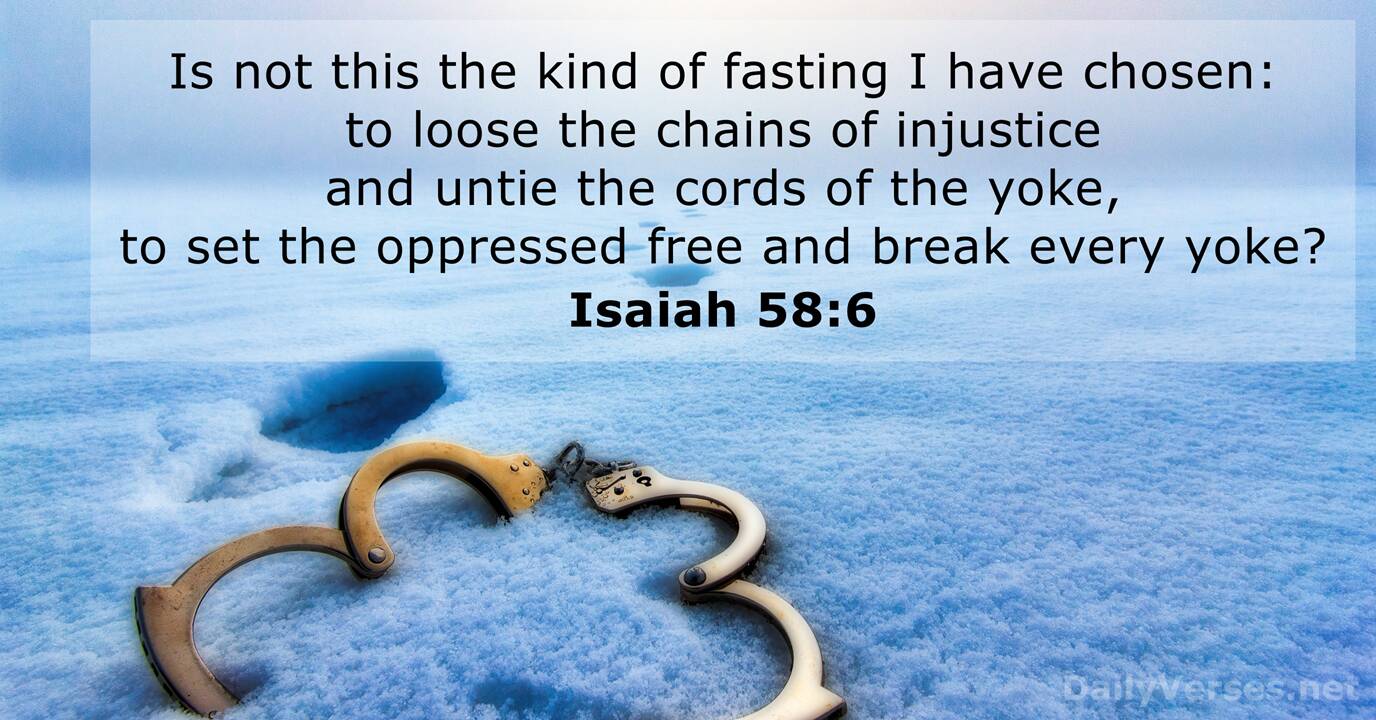
Fasting and praying for faith to free us from oppression

 11 Bible Verses about Fasting - DailyVerses.net

Bear up the hands that hang down, by faith and prayer; support the tottering knees.  Have you any days of fasting and prayer?  Storm the throne of grace and persevere therein, and mercy will come down.  --John Wesley

These days there is a lot of weeping and wailing and gnashing of teeth concerning the national sin of racism. Woke liberals, who are the most emphatic and dogmatic, like fundamentalist revivalists focus in on what they feel is the very worst kind of racism, which is white supremacy. All white people stand accused of it.

"White supremacy," they say, "is kind of like high fructose corn syrup. Very few people would purchase a bottle of it for themselves, but it's cheap, palatable, effective, and an ingredient in just about everything. To me the experience of opening my eyes to white supremacy was like realizing that high fructose corn syrup is a component in everything I picked up off the shelf at the supermarket--even in things you wouldn't expect. Just a constant refrain of, 'Seriously? It's in this too?' If you don't really care and aren't actively looking for it, you likely won't find it. You'll just consume it thoughtlessly. Those who are adversely affected, though, will be rigorous in identifying it because a failure to do so is harmful. They will look harder and find more." (Source: Twitter @absurdistwords Feb 26)

I suppose the remedy to this particular national sin is to confess my white supremacy, repent, and embrace BLM doctrine. Only then will all men be able to walk free together hand in hand, at least until another crisis emerges and we are again accused of a different societal transgression.

I submit to you that we should take a step back, and take a broader view. White supremacy is a sub-set of the sin of racism, which is a sub-set of the sin of pride. Pride itself is a subset of the sin of rejecting the grace of God that came through Jesus Christ. Romans 12:3 says, "For by the grace given to me I say to everyone among you not to think of himself more highly than he ought to think, but to think with sober judgment, each according to the measure of faith that God has assigned." The cure for this particular sin, then, is Jesus. He is the cure for pride and the other so-called "deadly sins", therefore He is the remedy for racism and all the other sub-sets of sin, all of which our nation is guilty.

The disciples of Jesus were guilty of a certain amount of pride, as well, a pride that led to frustration and arguments within themselves and within the religious leaders of the day. Let's look at Mark 9:14-28 to see more.

And when they came to the disciples, they saw a great crowd around them, and scribes arguing with them. And immediately all the crowd, when they saw Him, were greatly amazed and ran up to Him and greeted Him. And He asked them, "What are you arguing about with them?" And someone from the crowd answered Him, "Teacher, I brought my son to You, for he has a spirit which makes him mute. And whenever it seizes him, it throws him down, and he foams and grinds his teeth and becomes rigid. So I asked Your disciples to cast it out, and they were not able." And He answered them, "O faithless generation, how long am I to be with you? How long am I to bear with you? Bring him to me." And they brought the boy to Him. And when the spirit saw Him, immediately it convulsed the boy, and he fell on the ground and rolled about, foaming at the mouth. And Jesus asked his father, "How long has this been happening to him?" And he said, "From childhood. And it has often cast him into the fire and into water, to destroy him. But if you can do anything, have compassion on us and help us." And Jesus said to him, "If you can!? All things are possible for one who believes." Immediately the father of the child cried out and said, "I believe; help my unbelief!" And when Jesus saw that a crowd came running together, He rebuked the unclean spirit, saying to it, "You mute and deaf spirit, I command you, come out of him and never enter him again." And after crying out and convulsing him terribly, it came out, and the boy was like a corpse, so that most of them said, "He is dead." But Jesus took him by the hand and lifted him up, and he arose. And when He had entered the house, His disciples asked Him privately, "Why could we not cast it out?" And He said to them, "This kind cannot be driven out by anything but prayer."
Okay, there's a lot to go over here, so let's focus in on a few things that stand out. You remember the prior passage, where Jesus took three of the disciples with Him up the mountain (Mark 9:1-13). You will also remember in Mark 6 where Jesus gave them authority over sickness and over demons, and sent them out two by two (Mark 6:7). These are the same disciples, all with the same experience: "And they cast out many demons and anointed with oil many who were sick and healed them." (Mark 6:13).

Frustration leads to dissension

When Jesus approached the multitude with Peter, James and John, He saw the scribes arguing with the other nine disciples. The Greek word used here is συζητέω (syzētéō), meaning to investigate jointly, i.e. discuss, controvert, cavil (make petty or unnecessary objections); dispute with. Scripture doesn't go into much detail, but based on our experience of human nature, we can kind of figure out what went on here. The man, maybe a Scribe himself, has a son with both a spiritual need(demon possession) and a physical need (epilepsy, or some other seizure disorder). Relying on past experience, the disciples took turns speaking to the boy, but to no avail. They may have begun accusing one another of unfaithfulness. "Simon, if you weren't so zealous, God might have answered you." Or maybe, "Judas, if you weren't so stingy with the moneybags, maybe you could heal this poor boy."

Anybody who has had an unhappy customer ask to see a manager might understand the disciples' reaction. When the people asked to see Jesus instead, they could only say, "Jesus isn't here, I'll do the best I can." This, in turn, might have led to discussions about their best not being good enough. That would describe the reaction of the crowd when Jesus appeared on the scene. To their utter amazement, Jesus showed up at just the right time. Someone in the crowd may have shouted, "Hey look, there's Jesus; let's ask Him." So they all ran up to Him and greeted Him heartily.

Focus on the wrong problem

It strikes me as odd that the man in verse 17 identifies the unclean spirit as one that mutes his son. According to Thayer's Greek Lexicon, the evil spirit was identified as a mute spirit "because the defects of demoniacs were thought to proceed from the nature and peculiarities of the demons by which they were possessed." In other words, the boy was mute because it was a mute spirit that indwelt him.

As frustrating as it must have been for the father of the boy to ask time and again, "Son, what is wrong?" and to have no answer, his being unable to speak was not his greatest problem. The demon was set upon destroying the boy. Only later does the man admit that not only does the demon manifest in seizures with grinding teeth and foaming at the mouth, but it also throws him into the fire or the water to destroy him. How often must the father have had to rescue his son from burning or drowning without being able to address the root cause? John 10:10 says, "The thief comes only to steal, kill, and destroy. I came that they might have life and have it abundantly."

The problem was not just that the boy could not speak; it was that he was shriveling up and dying because the demons that beset him were set upon his destruction. The answer to this problem, as it is with every problem on earth, is Jesus.

Faith like a mustard seed

The poor father inherently knew that Jesus was the answer. He just needed a little encouragement. He told Jesus, "If you can do anything, have compassion on us and help him." Jesus may have raised his eyebrows here. "If?" He asked. "If you can? All things are possible for one who believes." The man answered with what little faith he had: "I believe; help my unbelief!"

Later, when the disciples were alone with Jesus, they asked him about their inability to do what He did, what they had been able to do before. Let's read Jesus' response in Matthew 17:20-21. "He said to them, 'Because of your little faith. For truly, I say to you, if you have faith like a grain of mustard seed, you will say to this mountain, "Move from here to there," and it will move, and nothing will be impossible for you'." Mark and Luke add these words: "This only comes about by prayer and fasting."

Faith in Jesus covers a multitude of sins. Prayer and fasting can build our faith, but it also can point out the sin that so easily entangles us (Hebrews 12:1). In this way, I agree with the Twitter analogy above, not about the specific sin of racism, but for every sin that separates us from God. "If we don't really care and aren't actively looking for it, we likely won't find it. Those who are adversely affected by it (like the father in this passage, or like the disciples, or like all of us) will be rigorous in identifying it because a failure to do so is harmful."

Jesus forgives us from all sin. He imputes His righteousness to us, and took our sin upon Himself on the cross. If that is all we know, that is all we need to know. However, continued or habitual sin can make us ineffective in our walk and work for Christ. To be effective as a Christian, we must purge all sin from our lives, not for our own salvation (for He saved us out of our sin) but for our work in salvation and service to others. If we are active in prayer and fasting, the Spirit of God will reveal our sin to us, and help us repent from it and stop doing it. In this way our faith can grow from the size of a mustard seed to the size of a large tree or shrub, and then how much more effective we could be for His glory.

Saturday, March 13, 2021

The mountain-top experience is a call to change

 How to Use the Mountain Top Experience in the Valley — To Unearth

But we all, with unveiled face, beholding as in a mirror the glory of the Lord, are being transformed into the same image from glory to glory, just as by the Spirit of the Lord.  --2 Corinthians 3:18

And do not be conformed to this world, but be transformed by the renewing of your mind, that you may prove what is that good and acceptable and perfect will of God.  --Romans 12:2

Have you ever had a religious experience that brought you so close to God you felt that you could reach out and touch Him?  People describe these "mountain-top" experiences as moments so precious, they wanted to stay there forever.  Some people describe these experiences as transformative, something that they will take with them forever.

Many times, however, it is in these very mountaintop experiences that God points out our sinful humanity.  Moses had several mountaintop experiences.  The first was when God spoke to him from a burning bush; God asked him to go back to the slavery and oppression he had escaped some forty years earlier, to lead his people out of slavery.  His response? "God, please send someone else."  Later, God met Moses on the mountain to give him the ten commandments, but when he came down from the mountain Moses threw the stone tablets down in disgust at the sin of the people.  Finally Moses was led up a mountain to look over into the Promised Land, but was not allowed to go there himself because of his own sin.

Another Old Testament figure who had a mountaintop experience was the prophet Elijah.  You remember when he called fire down from heaven in front of the false prophets of Ba'al.  Yet when Elijah came down from that mountain, he thought he was running for his life and got so depressed he wanted to die.

In our study today, we see that Jesus led his three closest disciples up to a mountaintop where they had a truly remarkable religious experience, yet they did not appreciate it until much later.

Now after six days Jesus took Peter, James, and John, and led them up a high mountain apart by themselves; and He was transfigured before them.  His clothes became shining, exceedingly white, like snow, such as no launderer on earth can whiten them.  And Elijah appeared to them with Moses, and they were talking with Jesus.  Then Peter answered and said to Jesus, "Rabbi, it is good for us to be here; and let us make three tabernacles: one for You, one for Moses, and one for Elijah"--because he did not know what to say, for they were greatly afraid.  And a cloud came and overshadowed them; and a voice came out of the cloud, saying, "This is My beloved Son.  Hear Him!"  Suddenly, when they had looked around, they saw no one anymore, but only Jesus with themselves.  --Mark 9:2-8

Several things stand out to me here.  The Greek word translated "transfigured" is metamorphóō, literally "metamorphosed".  This same word is translated "transformed" in Romans 12:2 and 2 Corinthians 3:18.  Jesus was literally changed from a physical being into a spiritual being right in front of their eyes.  Paul's use of the same word means that God expects us to undergo that same change, the metamorphosis from a physical creature into a spiritual being.

The Greek word translated "appeared" is optanomai, which to be allowed to be seen, or gazed upon; it also means to see, to gaze upon with wide open eyes, as if seeing something remarkable.  It has the same root word as our English "optical" or "optics".  I do not believe this was a vision or something they saw in a trance--the parallel passage in Luke actually says "they they were fully awake they saw His glory and the two men who stood with Him." (Luke 9:32).  In other words, this was not an optical illusion; it was happening before their very eyes.  1 John 3:2 says, "Beloved, now we are children of God; and it has not yet been revealed what we shall be, but we know that when He is revealed, we shall be like Him, for we shall see (optanomai) Him as He is."  Revelation 1:7 says, "Behold, He is coming with clouds, and every eye will see (optanomai) Him, even they who pierced Him.  And all the tribes of the earth will mourn because of Him.  Even so, Amen."

Peter recognized the spiritual significance of this event, and wanted to memorialize it.  He asked Jesus if he could build three tabernacles.  This was a reference to the Tent of Meeting that Moses had built, kind of a mobile Temple for use as a worship center while the people of Israel were traveling through the wilderness.  It also references the Jewish Feast of Tabernacles, set by God as a season of commemoration of the temporary structures or tents that they all dwelt in during their wandering in the wilderness.  Peter, at that time, was offering to do something as an act of worship, but it was apparent that God was not finished yet.  The audible voice of God interrupted Peter, and bade him listen. Sometimes that's is all we are asked to do in the moment, for when we hear the voice of God, it becomes a mountaintop experience no matter our physical location.  I think Peter realized later that the event was made special not because of anything he or the other disciples did, but because God spoke and the glory of His Son was revealed.  Peter later wrote these words:

For we did not follow cunningly devised fables when we made known to you the power and coming of our Lord Jesus Christ, but were eyewitnesses of His majesty.  For He received from God the Father honor and glory when such a voice came to Him from the Excellent Glory: "This is My beloved Son, in whom I am well pleased."  And we heard this voice which came from heaven when we were with Him on the holy mountain."
John may have been thinking of this experience as he began to pen his Gospel: "And the Word was made flesh, and dwelt among us (and we beheld His glory, the glory as of the only Begotten of the Father) full of grace and truth." (John 1:14).  And yet as these three disciples came down the mountain, they did not yet fully understand.

Now as they came down from the mountain, He commanded them that they should tell no one the things they had seen, till the Son of Man had risen from the dead.  So they kept this word to themselves, questioning what the rising from the dead meant.  And they asked Him, saying, “Why do the scribes say that Elijah must come first?"  Then He answered and told them, “Indeed, Elijah is coming first and restores all things. And how is it written concerning the Son of Man, that He must suffer many things and be treated with contempt? But I say to you that Elijah has also come, and they did to him whatever they wished, as it is written of him.” --Mark 9:9-13

Jesus tried to get them to see that even as the glory of God rested upon Him, He would have to be killed as a sacrifice for them.  Not to worry, though, because He would rise from the dead.  This was over the disciples' heads, as they wondered what in the world He was saying to them.  They couldn't begin to understand.  But instead of asking Jesus about this directly, they had a different question.  Since they had just seen Elijah, it reminded them: why did scriptural scholars of the day say that Elijah must come first, before the Messiah?  Jesus answered that Elijah had come, in the form of John the Baptist.  Unlike Elijah, who was caught up into heaven without tasting death, John had been killed; the Son of Man, also, must suffer many things and be treated with contempt.

The disciples did not yet fully realize the significance of the events they had just witnessed.  Coming down from the mountain, they started arguing among themselves, as sinful people do.  It was not until after the resurrection that they understood fully that this mountaintop experience had been truly transformative.  They did not continue as they had been.  How could they?

Synonyms for Metamorphosis starting with letter E5 Metamorphose Antonyms. Full list of opposite words of metamorphose.